
13 Writings About Music 1993-2001
Most writing about music is just chugging along. Why read what is largely boiler-plate, or tunnel-vision reviewing? Or just consciousness raising for the converted? Or just poor writing? Better to put a CD on and listen, or go to the movies.
But I love reading really challenging writings about music: by Cage, by Adorno, by Wagner, by Feldman, by Tom Johnson in the Village Voice, by Alex Ross in the New Yorker, by Schopenhauer, by Debussy, by Dalhaus, by Satie, by Schumann, by Susan McClary, and by whomever has interesting things to say and a compelling manner of saying them. It doesn’t matter to me whether the writing is poetic, journalistic, metaphysical, analytical, satiric, historical, erotic… It follows that I don’t much care if it is found in a review or in an article.
The weakest form of article, one that I regard as essentially a cop-out, is the interview form. It’s dullsville just to plod through the flatness of the form. Only the very rare interviewee is able to say an interesting thing inside the form. And usually only if allowed to go on and on. Morton Feldman’s 1964 interview with Robert Ashley is so good because it allows an inveterate talker to talk on and on. It gets better with accumulation. Ashley eventually turned the text of the interview, verbatum, into a performance piece (Morton Feldman Says, recently performed by the DownTown Ensemble with Bill Hellermann playing Morton Feldman). Such moments of inspired talking turned into text are probably rare in music. So let’s not make it out as the best way to get inspired music writing.
It’s time to admit something. I like to be inspired, either to think about the music I’ve heard or will hear, or to think about composition and creative issues surrounding it. Perhaps in doing so, the writing calls attention to itself. So much the better, if it calls attention to a thinking mind playing out its ideas. Awful, if either the ideas are dreadful, or the manner of telling is debilitating or worse. Both the fine and the dreadful can be found in a nice little magazine, The Open Space Magazine (published in Redhook, NY and on the web, edited by Benjamin Boretz and Mary Lee Roberts. I am also a contributing editor). It takes time to sort out what’s valuable in a broadminded magazine like Open Space. Especially if one is not a fast reader. Again the CD and movie options beckon.
I don’t believe as René van Peer does that “a review should transcend the personal position of the writer.” (Musicworks No. 80, page 4). I don’t think it should transcend, but even more, I don’t think it can. A personal position is deeply embedded within any writer/thinker and informs the verbal expression. Even a welter of “mere” opinions may accumulate into a fascinating individual sensibility, or an aesthetic perspective, something that brings the reader some insight even a negative or judgmental insight. These too play a part. Nicholas Slonimsky’s A Lexicon of Musical Invective, is not a trivial book. Jokes about reviewers, parodies of hateful academics, these things can be valuable cultural criticism. I prefer such, certainly, to the feel-good kind of rhetoric found in some nameless journals or little music Blätter. Opinionated prose has a place in music writing. It can also be exhausting. Again let examples be nameless. Even better, supply your own.
I like very much the summing-up last two paragraphs in René van Peer letter quoted from above: Reviews should have a larger aim of relating to issues of concern to the readership of a (any) magazine. Though there is some value in simply having been there, heard that and simply reporting information, isn’t it much better to have this function combined with inspired idea-mongering—I mean points of view and ideas about our current musical, even social or political, concerns? Besides simply reporting is not possible. There is such a thing as simple-minded reporting, but all parts of the writing act conspire to have a point view that filters events experienced.
September, 2001 (Published first in Musicworks, letters)
From a letter to René van Peer, November, 2000
But about minimalism, you imply differences in saying that Tom [Johnson] was not a minimalist—differences that I don’t think matter to the idea of minimalism. I don’t make a distinction: the fact that certain composers (La Monte Young, or early Glass, early Riley) may have used very few pitches or rhythms and Tom may use more, and also that he uses less obvious forms of repetition, doesn’t make him a non-minimalist in my view. I see the whole spectrum as including repetitive AND algorithmic composition. I think it proceeds from the same source: a rethinking of form (eg. modular forms), a rethinking of counterpoint (phasing, for example, is a canon, but with a difference), harmony (a process, not a set of functional chords), etc. I put myself in this spectrum even if pure rigor was never my aim.
Kyle [Gann] has a medievalist bent: There is an Italian early Renaissance philosopher, can’t get his name back at this moment, to whom Kyle is indebted in some way for his theoretical thinking. Somehow he derives his tuning ideas and other things from this guy. Anyway, his ideas intersect with the ‘systems’ ideas which Tom and others have (David Feldman, a
mathematician-composer), but probably he is more in the direction of Tenney and Larry Polansky, even though these two have been touched by minimalism from time to time. I think Totalism is an un-useful idea,
don’t know what makes something totalistic… But I grudgingly agree that Postminimalism is perhaps a useful descriptive term. Anyway, I can hardly deny its usefulness, since Kyle has officially dubbed me a Postminimalist. OK.
By the way I always HATED the way that Glass and Reich early on denied they were minimalists. Cowards! Western music proceeds dialectically with—isms. Always has, maybe always will, or maybe not! But the denial I thought was a public relations stunt to sugar-coat their musical pills by getting themselves under the radar detector for ‘intellectual music’ which would turn off potential fans and is part of the pop/anti-intellectual tendencies that all American artists have to bow down to, even if they are friendly to pop and other vernaculars while pursuing very different kinds of music.
Well enough cultural criticism for the moment.
It’s good to talk about all this stuff now and then. Thanks!
HARMONY in progress
I can’t believe I’m stuck in a reverie about harmony, chords and progressions. I’ve got a set of chords with three-note clusters on the bottom, various intervals on top. I’ve got another made up of superimposed thirds of various kinds, also a cluster-like sound. I’m separating them into sub-sets, changing ranges of the whole, of the subsets, giving them the Ruggles “test of time” (banging them repeatedly), thinking furiously and getting almost nowhere. Why?
First of all, every arrangement, every connection, every voice-leading is fraught with associations in music from 19th and 20th centuries. These associations bring a penumbra of visceral reaction, a moment of congruence with the “affections” represented in those musics. This yielding to a theory of musical emotion so openly pursued in the 19th Century, and the spillover of that yielding into 20th Century popular music, the opposition to it (while at the same time its use) by many 20th Century “modernists”, the full-scale “retreat” of the neo-romanticists into that vocabulary — all this creates of tangle of contexts which seems to make clear thinking about harmony impossible.
But maybe I’ve got it all wrong. Clear thinking about harmony is really impossible because harmony is this very rich soup of contexts, cultural moments, penetration into the so-called extra-musical. There is no other “uncontaminated” realm.
But if there is, it must belong to John Cage and James Tenney. Tenney’s reflections on Cage and harmony and his own complex multi-dimensional scheme of harmonic space is probably the only theoretical work disassociated from the contextual mess I have painted. Unless, of course, you include the serialist mapping of musical space, where harmony is not considered essentially different from melody because all serial structures and processes apply in a non-differentiated way to both vertical and horizontal textures.
But I do not want to be distracted by either the serial or the Tenney approaches to harmony. I want to immerse myself in the messy phenomenology of chord and progression, because I am intrigued with this messiness and I am composing with this messiness at hand.
What is the moment-to-moment effect, what are the longer-ranged effects, what progressions (in what permutations and ranges) do what musically?
It seems that association, affect, utterance are bound up with each other. A functional bass of dominant to tonic emerges, a “tension/release” progression occurs, a single unresolved suspension, or appoggiatura, or deceptive cadence, or a feeling of suspense from non-resolution throughout a progression. These are unavoidable observations to anyone trained in the sounds of 19th-20th Century harmony. So then the question is, should one try harder to avoid the associations, or should one embrace them and somehow put them to use?
Unclarity, unexpressed motivation pervade the verbal responses of composers. Critics and theoreticians take their cues from this combined inarticulateness and concentrate on style, musical ideology, historical descent of one generation to another. The obvious phenomena and epiphenomena of chords and their progressions are like emperors without clothes: we shall not notice. We listen but we do not observe or are too embarrassed to comment.
One compositional school after another constructs matrices which solve the harmonic problem by papering it over with new paradigms for composition. We have, for example, harmony is nothing but the outgrowth of contrapuntal structures: make your voices according to some principle and that “justifies” the resultant harmony. We have minimalist procedures: take your chordal structures or progressions as givens and subject them to minimalist processes: additive or repetitive, or gradual change, or whatever. The sounds themselves are beyond comment. Serialist theory uses the row and its subsets as the justification for harmony. Only the neo-romanticists and neo-classicists have no theory to account for their chords. Is there less or more than meets the eye in their avoidances? Once pop music is disregarded, jazz seems to be the most unselfconscious in its use of harmony: for jazz, nothing has changed, chords and progressions remain exactly what they always were: the material for “changes” and substitutions, and the fundament for improvised variations. The affect and effect from “the past” is embraced readily and openly with no apology or need to redefine. In fact, the past is the present, as it is with popular songs which use harmony unselfconsciously as if universal and never changing. So harmony continues to be used, the “past” continues in the present, the same intervals, tunings, bass lines, voice leadings, numerals reappear, but all thinking, prescriptive or simply reflective has, it seems, come to a halt.
Which throws it all back on the practitioner of new music. Lost in some never-never land between acoustics and associations, we look for a handle.
Perhaps it would clear the air if we declared that this indefinable soup is the very essence of what makes Euro-American music (“Western music”) what it is. We can’t avoid it and we can’t get outside of it to think about it because it is us.
[to be continued]. First published in News of Music 14, 1994
Harmony—sex
Harmony is like sex. We cannot successfuly analyze it because we are of it. Or is it like the Heisenberg Principle: the closer you get to it, the harder it is to see it. One thing we know about both harmony and sex. They function. Harmony is functional. It causes smaller and larger climaxes (like orgasms). Sometime it doesn’t work at all, or feels sleazy or cheap. Like bad or non-working sex. All of this is culturally determined. You cannot communicate harmonically or sexually trans-culturally. Or at least it is not easy, takes special attention. The automatic triggering accomplished by the culturally coded rhythmic/melodic context of chord progressions is like the coded sexual signs that trigger an erotic response. If you are not of it, you might miss it. Perhaps harmony is more coded than sexuality, but that’s another discussion.
First published in The Open Space Magazine, issue 1, Spring, 1999.
Harmony Diary: From a letter intended for Kyle Gann, 6/95
I haven’t tried to analyze the harmony, but two things come to mind:
1) You’re the person to think about the burning issue I’m trying to articulate in this little paper I am enclosing—I’m really curious as to your response.
2) Your harmony seems connected up in some spiritual and technical way to similar uses of poly-modal triadic (especially minor) successions by Vaughn-Williams, and by Roy Harris (I always liked Harris’ version better because it included unexpected 7ths, other dissonances, and sly timbres while Vaughn-W. is just a plain excellent orchestrator, more than interesting harmonist. I put you in the Harris category of interesting). The attraction of harmony is the attraction of “our own culture,” don’t you think?, its depth theme. Then, weirdly, I realize that some of my most passionate harmonic attractions are the way folk music of the Balkans, or of the Andes use the Euro-harmonic vocabulary, but in these truly minimalistic yet powerful teleogical (as in Euro-harmony) ways. Stunning cultural borrowings, more so than any post-post-multi-American experimental composer borrowing from the “East”, let us say. Well, I’m exaggerating, just a little, or going on in a Peter Garland rampage against “Europe”. But no, I don’t really share Peter’s denigration of European music. Just of SOME European music. No names!
Some observations: In Gann’s Sun movement from his astrological studies there’s a very short ritornello-type phrase with a prominent minor-major progression (perhaps some different continuations), but it slots-in the harmonic idea effectively simply through periodic returns—repetition, redundancy. It says: “harmony: listen-up, please.” And it becomes articulate and expressive. More so than if it were a continuous ostinato.
In tying Gann to Harris’ harmonic style, I realize that what I must be focusing on is the underlining of the harmonic strand in such a way as to have it emerge from the texture as a “separate story”—an interesting, beautiful story. Is this the composer’s doing or my own perceptual initiative? Seems that for harmonic progression to be meaningful it must at least be projected (underlined). What else must it have?
What Gann and Harris may not have all of the time is the other necessity for meaningful progression: a sense of progression, rather than mere succession. That is, the routinization of a textures with their distantly-related minor triads simply spinning on as an environment does not of itself make a progression.
Thy Fearful Symmetry // Experiences of Symmetry
I recently came across an analysis of symmetry in the music of Morton Feldman. I saw displayed on the page various A’s, B’s , A’s.and X’s in various symmetrical and near-symmetrical patterns. These were to be juxtaposed with the remembered characteristics of certain pieces by Feldman—and this in turn led me to my favorite paradox of musical thinking:
What has the symbol-pattern A-B-A, for example, got to do with my experience of the time slot filled with the this–that–this musical sequence of moments?
It has something to do with it. The musical sequence shares logical form with ABA. Or, differently, ABA can be used to describe something about that piece of music. But do we experience ABA when we are listening to the piece so analyzed? Perhaps if we are taught to do so. The teacher says: what is the form of this piece. We say: ABA. QED, we experienced ABA. But this simply begs the question of how symmetry is experienced.
Some people (see James Gleick’s Chaos) have lighted on the hypothesis that our sense of beauty comes from our perceptions of environmental patterns with their self-similarities, “crippled” symmetries, disrupted or varied regularities. Considering the appreciation of landscapes across many cultures, landscaping, and landscape painting, it is a seductive hypothesis. Music at the tempo of heartbeat, or in walking rhythms is found in many cultures. But, of course, culture does not always operate in the manner of nature (see Cage’s early writings, and his relation to Buddhism, Zen and other, where he takes it as an imperative that art mimics nature in its “manner of operation”). Still, there are many suggestive relationships between perceptions of natural orders and perceptions of art works.
So, to ask it again: does musical perception resolve into one whole the composed self-similarities a composer makes of, let us say, nested ABA patterns?
The early process oriented minimalists liked patterns uninflected by natural patterns. Tape loop pieces and all loop pieces, in fact, positively declare their “downbeats” to a very sensitive pattern recognition ability of our species. We hear: not-found-in nature. (Let’s exclude the world of motors and mechanized industrial repetitive patterns—they are “manmade” as are tape loop pieces). Loops tell us art or communication grammar is happening. Only when we “cripple” the loops with destabilizing or unpredictable events, do we have the possibility of arguing a family relation between art works and our perceptions of natural patterns.
Impressionism, statistical clouds of Xenakis, environmental New Age recordings of rivers, surf, rain, whatever, these are just a few homages to the varied repetition we seem to see (and hear) in landscapes and soundscapes. Again, can we pass from this to a so-called standard of beauty? Does crippled symmetry become Asymmetry-within-symmetry and vice versa?
I can’t help circling round and round this issue avoiding the obvious, which is: Both the crippled symmetry of art and the crippled symmetry of “nature” give pleasure, on a scale from the very slightest to the very greatest. I don’t think that is the end of beauty or of aesthetic pleasures, but it may be just woven in there whether you notice it or not, just staking out a little territory in your psyche. Meanwhile you may be consciously oo-ing and ah-ing over big architectonic constructs describable in music analytical terms only, or the hugely satisfying dramatic structures of late 19th Century symphonic works. But down there at the unconscious level, that scandalously beautiful double-bass pedal point is just the rough-hewn crippled symmetry of horse-hair bow upon hard gut string. Don’t diminish that perception! You could say that horse-hair/gut perception “softens up” the discerning listener, who can then split their consciousness so that other grand designs are noticed and appreciated.
And what do we think about ABA, again? Now should we try to venture a theory? Well for one thing there is “charge” we feel when it comes time for one of those great recapitulation moments in classical music, pick your favorite—first movement of Mozart’s 40th Symphony, anyone? But that “charge” at the moment the Recapitulation begins is not symmetrical with anything in the Exposition. That was then. This is NOW. So, QED, the symmetry of ABA in music cannot be anything in time-based art like what it is in visual arts. Or am I just being contentious. The experience of ABA-type symmetry in music has a little to do with the equivalent in visual art. Again because of the basics: same is same, different is different. We parse both the world and art in such basic categories of Same, Similar, and Different, over and over and over again.
ALLEGRO IS IN DISPUTE: CAN ANYONE UNDERSTAND?
Fast music is peculiar, in classical music, in modernist music, in post-modernist music. But not in dance music. Of course, not. But no, let’s put it differently: Fast music is perfectly understandable in classical music as is tragically slow music. They are both part of the affective inheritance from the Baroque period. Music had specific affects, and in the most simple terms, fast music represented one area of affects and slow another. As the affects disappeared into the modernist period, all medium to slow tempi become just points on a metronomic continuum, not a set of separate things with special characters like tempo di valse, marche funebre, etc. But Fast Music, somehow, resists its disappearance into that characterless but broad continuum of non-fast music
When we say fast or slow we should be clear that we talk of pulsations, event flow, harmonic rhythm (the speed and placement of chord changes). When ever a composer of “contemporary classical” music writes a fast movement or even a fast part of a movement, it almost always has “character” (even if all we can call it is “excitement”), a kind of affect that would lead some Times critic to say things like “a whispy filagree”, “a wild, demonic orgy of pulsations”, “a stark, craggy, elemental show of force”, and on into metaphor-land. Fast music can’t readily be made “abstract” (“absolute”, non-programatic in 19th Century terms) in the way that moderate music and slow music can be.
First published in The Open Space Magazine, issue 1, Spring, 1999.
Class Conflict in Music
What happens when the academic musicologist, turned populist and feminist, attacks the elitist academic serialists (et al) and a representative of the latter who is now a Paul-turned-into-Saul (a non-academic) then defends the academic tradition of music and ridicules the reformed musicologist (above) mercilessly and perhaps properly, yet has nothing more to say in support of the power-mongers of intellectualized music than that it’s a legitimate minority too, worthy of its day in the sun?
No mention in this interchange of the ridicule, of the decades-long, even centuries-long dismissal of vernacular musics as unworthy of culture and education. Those who create the canon and the schooling for the canon, until now, have held this power of ridicule and dismissal. We’re not talking about Schenker and Schoenberg. They weren’t the powers, but they had their views, their insights, their oeuvres belatedly made into the ruling concepts of music.
Cape Breton Fiddling: Introduction
The art of Cape Breton [Nova Scotia] fiddling consists of two things. The first concerns the way a tune is played. The second, perhaps more amazing to me is the art of combining several tunes into one seamless whole.
I became enamored of both aspects of the style in 1972 during my first visit to the island. But it is about the second aspect that I often obsess, and often try to reproduce when I am playing Cape Breton fiddle music. Let me explain. Because I play the music on clarinet, not violin, I know I cannot produce the exact sound of the fiddler, nor even the exact texture. For instance, I cannot play “double-notes” (double-stops in classical music), and the sound of the fast ornamental grace notes and “cuts” (fast repeated notes which in effect accent—or ornament—a main note) sound differently on clarinet from violin. I’ve found some reasonable substitutions, but the “same sound”—no. Even so, the local players loved to hear me play the tunes on clarinet. I think in their unconscious mind, and for good acoustic reasons, the clarinet sound reminded them of the bagpipe, and in a kind of funny mental cross-cutting, my playing reminds me of a melding of the sound of the bagpipe with the accentual style and drive of the violin playing.
As I understand it, the majority of the traditional tunes played in Cape Breton (and were either brought from Scotland by the immigrants or composed in the new land Nova Scotia) were piping tunes. And piping is still actively practiced in Nova Scotia. Anyway: bagpipe and violin—wind and string equals clarinet.
In repeated visits from 1972 to the present, whenever I learn to play a tune, I work quickly and intuitively to reproduce that part of the sound which is possible on clarinet. And that part is not so much about timbre, but about rhythm, accent, phrasing, and the kind of lilt or lift needed to play the music satisfactorily. Once I have gone as far as I can go with the sound, I concentrate on the “strip” which is what the locals call a medley of tunes made for either dances or for concerts of the same kind of music. Of course, in Cape Breton, a concert usually includes some dancing because individuals will step dance with a fiddler and pianist playing a medley.
I am calling all of this the first of the two aspects of Cape Breton fiddling style. And this is all I will say about it. I want to concentrate on the second aspect: the art of combining several tunes into one “piece” (as we call it back home).
Skepticisms, July’97
Perusing articles in Leonardo Music Journal and Musicworks: Take Truax abstract: “such magnification allows the inner ‘voices’ of such sounds to be explored and their imagery and symbolism to be brought into the compositional process,” LMJ 1992, p.37). Take the “Skyharp” (sensors map sound and light in an environment, LMJ, 1993). Improvisation and shamanism, Musicworks #66, p.14).
Guiding assumptions: the microscopic is where the essence of our world lies. Or the “giving up” of rational choosing schemes is where knowledge is to be found.
Lethal Aid(e): Text by Connie Samaras, Computer Voice and Music by Daniel Goode, 1993.
—letters and numbers are the embedded commands for the computer voice; respellings also helped the computer to speak better; “embedded” has an unintentional ironic cast during another unpopular war, this one in Iraq.
During the Truman years, a secret government was formed, so that the military, intelligence, and flejling, multi national, corporations, could, creatively, shape, foreign policy without congressional, constraints….. Over the years things pro-gressed nice-lee for the “National Security Council”, but, it, was, with the, election, of, Ronald Reagan, in 1980 that they were able to, uhcheeve, a massiv, expansion of power……
In testing the limits of this, new, found, freedom, however, they began to fear the risk of public expo-sure. So, to off set, any public out cry over the discovery of a subterranean, clan dess tine, government operating, outside the, workings, of Congress, they decided to fabricate a boyish heero, embodying the myth of American individualism, to offer the media, should anything go, wrong. For this assignment, they selected Lewtenant Colonel Oliver North, and, installed him in the basement of the White House.
North, was selected from a group of highly motivayted volunteers by the late director of the CIA, William Casey. Casey was impressed both by North’s ability to carry out, orders without question, as well as his <<P9 in>>ability to tell right, from wrong. He also admired North’s creea tivity, which intelligence sighk i etrists, traced back, to the sigh cotic episode, North suffered once he realized, the V et nam War, was truly, over. This, the CIA felt, could be, a plus, since North’s assignment was to impliment, what they considered, imaginative, unconstitutional, acts, like, invading Grenayda, and allowing no, press, coverage; mining the waters of Nikkawrawgua; stepping, up, a rain of, tehrr rer, and mass murder in El Salv a door; bohming, Libbia; financing a group of mercenaries, in Central America, by selling arms to Iran.
Beecause, North was hired to play a po ten chul, scape, goate, Casey wanted, <<P8 equilly>>, creative people, available, to work on, North’s, trial, image, should charges, be pressed. En<<P9 curraged>> by colleagues who had begun collecting, art, with new, found, wealth, from upscale trafficking in druggs, Casey expanded the, arte, department, at the CIA and instructed them, to assume, a more, avant-garde approach, in their media constructions.
As it turned out, North did go to trial and the people in this division got to try out many of the ideas they had worked so hard on. For example, they had drugs administered to North to make his voice crack so that he would appear sin ceere and boyish, every time he opened his mouth. They hired a former model for his secretary knowing that the two would be ro manticly linked, making people feel, less, resentful that the heerings were displaycing, daytime soap operus. They designed one of North’s medals so it would look like a happy face when pho toe graphed by, video camerus. A, TV, movie was scripted of his life and times. The Quaker, Oat, box, lo go, was, digitally, altered to resemble Jehrry Falwell, thus preparing Americans for the preacher’s campaigns to raise money for “,paytriut, Oliver North’s Deaf ense, Fund”. But the most siphisticated concept they developed took into account the spectator’s actual, physical, environment during the media, <<P9 event>>.
Having access to both Nassa’s, and the EPA, pro jections of the Greenhouse Effect, they decided that the siveere climatic changes in store, would provide, the perfect, interactive, settings to induce, mass delerium, through real time, television. Thus, North’s appearance at the 1987, Ir ran/Contra heerings was,, deelayed by his council, to coincide both, with the fourth of Ju lie ,,, and with one of the worst heat waves, in recorded history.
Next, knowing that July 4th 1988 would again bring both record high temperatures, and also one of the worst drouts since the, 1930’s,, <<P8 and>> because they had been, instructed, to a sist, ex-CIA director George Bush’s presidential campaign, they decided to blow up, an Ir ranian, jet, airliner, on the third of July, so that it would dominayte the news, coverage the next day. Not only was this event staged to, dis so siayte, Bush, from North, and the Ir ran, contra scandal, it was also thought that the heat-crazed, public would enjoy the pictures of the explosion once fire works had been <<P7 pro hibited>>, in most parts of the country because of the drout…
Finally, when it was clear that North would be convicted, they had his sentencing delayed to January, 1989, because it was pro jected that the country would experience a, four, week, thawh. at the beginning of that year. Since the fawlse sense of spring would uplift everyone’s, spirits, it was hoped that this would make for a more fayvrable reception of the, ri<<P9 di>>culusly, light sentence North was, slotted, to rece<<P8 eve>>. 200 hours of community service, enlisting North as a “soldjer in the war against drugs”. This sentence, also designed by the art, division, of the CIA, was not considered an ending to the North episode, but rather the beginning of a new project for the upcoming deck aide.
Because of pro jected changes in the Soviet Union and Eastern Europe, it would no longer be, va ya bul, to package, agendus, for social control, under the simple banner of, “fighting the cancer of communism”. Instead, new guises, had to be devised, the first of which was Bush’s pledge to. “<<TV9P6 battle, this, plague, of drugs, upon, <<P3 our, <<P7 lande>>.
SECRET CAMERAS—IN NEW YORK CITY
You are peeing against a wall because there are no public facilities for blocks.
In a park, you are hidden from passersby, yet fully clothed and furtively masturbating in the front of a secret camera.
Two people are passionately kissing—is one harassing?
Two people who could never marry are passionately kissing. They are the same sex——in a public library. A camera catches them.
Once cameras have reached a critical mass, they create “a total institution” (Erving Goffman).
Or as [former] Mayor Giuliani put it: “You don’t have an expectation of privacy in public space.” So don’t pick your nose.
First published in The Open Space Magazine, issue 1, Spring, 1999.
From a letter to Ben Boretz, February 9th, 1999.
…I’m stimulated. The words Situationism and Improvisation, the Disembodied voice are bouncing between my earlobes, making a deafening racket. I’m now going to go off half-cocked with ideas for the near future:
I want to actually talk to mainstream culture-makers. Actually I want to assassinate them. To do that we must put acid on their neural synapses.
Let’s see. Radio has been betrayed. We wuz robbed. The most enlivening, immediate medium for musician-thinkers and musician-doers is radio. Forget the internet, it’ll be problematic for too long a time. The obvious access and portability of radio that needs nothing but an on/off switch and a tuning dial (alright! a gain dial and an equalizer as well) argues that it is the most: democratic/powerful/potentially radical/cheapest/free-est from the necessary intercession of the priest-technician who ministers to the fallen and crashed computer—this amazing thing has been closed down, gagged, neutered, imprisoned, commercially exploited as both commercial and “Public Radio.”
Well, examples to follow. But when you said on the phone we needed a magazine to talk to each other, I thought it over, and I find I am too angry at the culture to leave it at that. I want us to have a razor sharp analytical voice that provokes the culture makers directly to respond to us. We should not let them off the hook. They claim to speak our language (radio, TV, media people), so let’s not be crank-letter writers any more (here I am swearing off an abominable habit that simply has put a lot of my energy directly into the Round File), just complaining one at a time so we can be dismissed one at a time. I want an association of pragmatic thinkers who will take on these targets mercilessly.
Here’s one little koan from “public radio.” A very hip, varied radio program called “Afro-Pop World” used to be broadcast on WNYC-FM (our “public radio” which Giuliani just off-loaded to corporate and foundation funders). When the station went “independent” (that means that marketing replaced programming, to suit those very corporate and foundation funders), “Afro-Pop World” was switched to the AM branch of WNYC. Though at a handicapped hour of midnight on Saturday night, that’s not the koan I’m after. Rather it is: Why AM, rather than FM? Answer: FM is better quality sound, so it is for better quality music. Folk music, ethnic music, pop music, African music is not serious music. Now this is what the elites of Columbia and Princeton music departments used to say out loud for decades and decades. But here is an act by the so-called makers of the public, non-elitist culture that deconstructs into exactly the same statement.
After our victory over public radio, we should work on the creation of physical spaces for our thoughts (that includes music, of course). We can use the internet, but we should use it to valorize the physical meeting ritual. Every time I see people lining up for a live event (usually young club-goers in Manhattan) it is brought home to me that the meeting place is still the locus mysticus. People want to rub up against each other in every sense of the word. The internet will never replace that. Tell a friend that something “really happened” at such and such a place and time, and that you were there to experience it; relate it, and you will make your friend jealous for not having been there.
Well, now that we’ve taken back public radio, and we’ve re-valorized the ancient idea of the face-to-face meeting place, nothing will be denied us. What next?
Let us reform the movie sound-track. Film (and video) is the lingua franca of the 20th and 21st century. So, what the hell is going on in those “treatments”, those pre-sold sound tracks, those enervating under-scorings, those bloated pig-bellied blockbuster sound tracks?
We should take on the poor (but getting richer) deracinated composers who make them, and their sound editors, engineers, and all their bosses. Our leaflets should pour down on their heads. We can embarrass them, and once exposure comes, well, some will at least be politicized, even if they can’t change their producers’, directors’ minds.
Finally we have to take on education. A young musician told me that when he asked his music professor at a large Texas university what was a gamelan, he got, the response: Debussy was influenced by the gamelan. When he persisted with his question what is gamelan music, the teacher, after a week, came back with a one-sentence definition from a dictionary.
But education will just be putty in our hands after all of our above accomplishments. After all, we spent our lives in education. We know how to handle “Them.” And we will! We’ve got the contacts!
All the best! Daniel

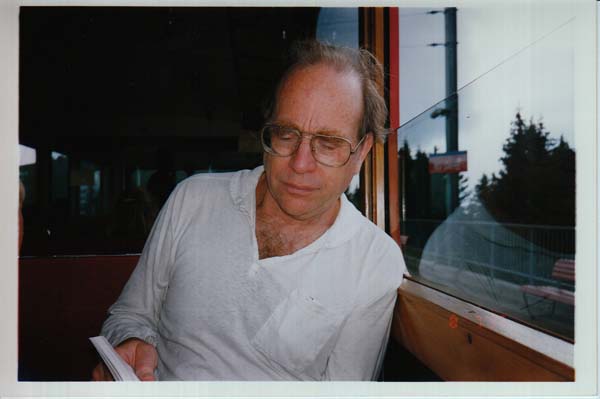
 Daniel Goode