Daniel Goode

Composer & Performer

Score Transparency

Score Transparency  

When you do no more than glance at a traditionally notated musical score, you can derive mountains of information if you are a score reader. That makes it a transparent instrument or tool. But the musical score is something of an elite item; many, most people cannot read or derive information from it. That means music derived from scores can be managed only by those who can. Composers who seek to reach the sources of music management must learn to use scores, must go to institutions or teachers who can teach them score literacy. These institutions and by extension, many, most who have passed through such are constrained by their training and its ideology to regard music making and notating in the ways that are represented by a musical score. And why not? A score is a wonderful invention, a tool, and a code of marvelous complexity and subtlety, such that developing a computer notation system that is only reasonably flexible to its demands has taken decades. Why would I not want endorse the use of the musical score and simply work for a more universal literacy?

Because of verbal scores and conceptual music.

But verbal scores are not as transparent as notated scores. One must read and understand each sentence, each phrase, and every invented or adapted symbol the writer uses. One does not learn as much by scanning and flipping through verbal scores as notated scores. And there are the ambiguities of language at every turn. My favorite is the last sentence in Pauline Oliveros’s ground-breaking conceptual/verbal piece, Teach Yourself to Fly: “continue…until all others are quiet.” Wonderful, but impossible if each participant follows the instruction. I am waiting for you to become quiet, you are waiting for me to do the same. Yet we will figure this one out, of course. Many such gnomic sayings in verbal scores are not so easy.

REFLECTIONS ON MINIMALISM

REFLECTIONS ON MINIMALISM

It is bracing and refreshing to read the dialogue in Musicworks #89 between Tom Johnson and Jim Burton who’s experimental music of the ‘70’s has recently been reissued. It is obvious that both of them are minimalists of good writing and speaking, though it may not be not the same use of the word, minimalism, as in the arts, but seems apt anyway. Both Johnson and Burton embody concision with maximum concentrations of idea and expression. These are characteristics of some musical minimalism as well. The question of whether Jim regarded himself as a minimalist in music, though, is answered by him in this quotation: “In the larger view…. Where I part from minimalism is that my structures are open-ended; I prefer to play with hints of structure and fleeting, incomplete structures that we sense around us.”

There was in the late ‘60’s a ‘70’s a kind of hard-nosed (perhaps machismo) emphasis on “rigor”, and it involved the minimalists in a proofs or demonstrations that they could be just as hard-nosed and rigorous as any serious serialist, chance-operationist, contrapuntist, or whatever was out there. There were of course real formal and contrapuntal—all sorts of—innovations floating around among us. These were duly noted, but not everyone’s cup of tea. But for some reason the systematists got to inhabit the word minimalism to the exclusion of the non-systematists. Even though Steve Reich and  Phill Glass eventually disavowed that they were Minimalists (why? was it a “career move” to disavow? or more like: “I am not, nor have I ever been a Communist), the fact that they and others got associated with the term, left outside of the minimalist universe all those passionately minimalist composers who didn’t use exactly these hard-wired processes, or used them tangentially. Jim Burton’s music sounds minimalist to me in the best sense of the term, even if his self-description as parting company with minimalism, quoted above, is equally true of his music.

Observation of natural processes, uses of these processes in part or whole (a stream flowing, wind blowing, natural echo chambers, etc.), these are part of the minimalist universe. Many composers were not interested in marching eighth notes with phase changes or cyclic overlaps. And even these seemingly cultural products: phasing, and superimposed cycles of different lengths were quickly noticed as being found in nature, or agricultural and industrial environments. The films and music of composer/filmmaker, Phill Niblock put non-systematic minimalism into a one grand opus that keeps growing every year.

What was and is still wonderful about minimalism is its saturation of the whole musical and aesthetic environment, and its connecting of cultural determinants of style with new observations of nature and physical processes. Even mental processes such as auditory illusions, hallucinatory experiences should be included in the phenomenon of minimalism: the connections between music and various mental states. There was even a sense that the “trance experience” in Western music was, some have said, an underground stream that nourished various musics from early Greek times through the perpetuum mobile pieces that are part of the 19th and 20th century repertoire. Some would say Erik Satie was part of this underground stream. The various composers of vocal chant-like pieces such as Pauline Oliveros’s Sonic Meditations should be part of this universe (even if trance experience is not how that composer would explain her ground-breaking pieces connecting her idea of meditation and observation with so-called strictly musical processes).

When it becomes necessary to map minimalism in all its facets, one thing will become clear: how counterpoint and harmony are subsumed into more powerfully generalized concepts which eventually will overturn 2000 years of medievalism in music pedagogy. Just as an example think about how pitch extraction, doubling formulae, self-similar melodies, Javanese colotomic structures are all contrapuntal actions. Harmony sequences are open to many more patterning schemes than the accepted chord progressions of the last two hundred years. These “actions” as I call them multiply the structural possibilities. In fact, the minimalists could be considered to have pushed rigor further than the serialists and even the “new complexity” buffs. The accomplishment was not only to make interesting musical structures, but that minimalist structures, algorithms, process formulae—whatever you want to call them—were part of the perceptual realm; you could hear the process unfolding. Aren’t wonderful structural underpinning even more so for being audible as well as demonstrable in the score? Even so, that was not always literally true of every rigorous minimalist piece, nor should it be. But processes can be discerned if not totally understood, and can, when attended to, make the piece more interesting to the listener. And then, often the process was perfectly audible, perhaps both simple and elegant.

As I said, counterpoint and harmony were redefined and expanded. But also invented were: open-ended forms, documentary forms, endlessly repetitive form…. What makes them all minimalist could be, should be the big analytical question of the recent past. It would be good to get started with this study. It would show conclusively and easily that minimalism was not just the passing “style” of two composers both with five letters to their last name. It was and is a much larger world.

—Daniel Goode, March 2005

Letter from Vienna

Letter from Vienna // Wien Modern–Wien Oldtime // 1999
-a kind of musical diary with themes, during a music festival

by Daniel Goode

I

October 1999

Shortly before leaving New York for Vienna on October 18, I talked by phone with a young Viennese sound-installation composer. He said “You are very lucky to be coming when you are coming….” He explained that the whole month of November was devoted to the Wien Modern music festival and I should get a festival pass (a huge saving) and, oh, don’t expect the music to be like Downtown New York music. I said I wouldn’t expect it. But somehow I couldn’t forget it. All the way through the festival I was haunted by what “downtown New York music” had been and still was to me.  You may see what I mean in the course of this chronicle, though my purpose is not to talk about my own milieu.

In 1971 I had taken my first trip to Europe and come by train to Vienna for a few days, where I attended an earth-shaking—to me—performance of Mahler’s Eighth Symphony. I had only just a little while earlier in London attended a performance in the Albert Hall of Mahler’s Ninth Symphony conducted by Pierre Boulez; fascinating but not moving. I wrote about these two experiences over the next year in a medium I weirdly called a graphic essay (indeed one component of it looked like a cross between a huge board game and “Pin the Tail on the Donkey,” a kind of kid’s collage). The title was Two Events and it was really a compositional diary.

So now it’s twenty-eight years later and I’m still writing a music journal on compositional themes, this time stimulated by the Wien Modern music festival of November 1999. I am concerned that today’s music be as profound as yesterday’s. I don’t really understand why it’s either not, or very rarely that way. At Wien Modern I did immediately understand that I was  looking at the European version of post-WW II Modernism. But because Vienna is a symphony town, the symphonic past is always here looking out at you as you behave “modernly.” In 19th-century Vienna the symphony became a totally absorbing art form without the need for story or stage action. It the source of Edward Hanslick’s conservative aesthetic of pure, abstract musical beauty but also of Mahler’s radical symphonic aesthetic that “The symphony is like the world: it should have everything in it.” I find that, for me, anyway and I would think for anyone who is at all susceptible to the past, the symphonic Geist acts as an implicit critic of the present. You may be able not to notice a string  quartet or a piano sonata, but along with that other imposing musical monolith, the Indonesian gamelan orchestra, if you wander into the presence of the Symphony Orchstra you will find it hard to shake its influence. So that is why, though I have started out merely chronicling my experiences of Wien Modern, I am soon thrust into a dialectic between today’s and yesterday’s New Music. At times the back and forth in my mind has had the ferocious energy of the ball in a tennis match. I was not amused.  Provoked by anxiety, is more like it.

Inevitably, I had to confront the root issue for anyone, I think, who takes seriously the implications of the large-ensemble form in culture. I believe that the symphony orchestra is different in kind from just a large collection of players playing together. It acquired that difference in meaning over time, so that by now we can say it has been “invested” with a special significance, something like a cross between being a distinct medium and–transposing a term from Asian culture–being a “national treasure.” We can have several attitudes towards this transformation of large ensemble into Symphony Orchestra and I’ll save my exploration of the issue till the end.

*******************************

November 15
         There can be no doubt about it: Tan Dun can compose. (Born 1957 in Hunan, China, he has lived in the U.S. since 1986.) With verve, variety, soulfulness, dramatic heft, with or without forays into the vernacular; with textures melting into each other with or without improvisation…moments I can wish I had composed, vastness or intimacy, each at his command. And yet, and still, he loses his way, squanders his creations, and it all falls down.

Red Forcast: Orchestral Theatre III (1996, 45’)  for Soprano, Orchestra, Video and Tape was performed at the twelfth Wien Modern festival on November 15,1999, with the composer conducting in what  looked like red pajamas. Well, red was  the theme, it seems. The large video screen (videotechnik, Mike Newman) showed lots of Mao, lots of protesters of the Vietnam war, lots of bombs falling, lots of smiling, marching, waving Chinese, lots of other familiar politicians: Kennedy, Nixon, Martin Luther King Jr., Brezhnev, Krushchev. The very young Beatles appeared and “Let It Be” pounded out from the stage piano. The soprano (Nancy Allen Lundy) moved about, crooning, carrying a portable tape speaking in German. A saxophone player (uncredited) played a beautifully nuanced series of opening riffs, then walked about to coax the opening sounds from the chamber orchestra arranged in a circle beneath the huge screen, monitors poking out on stage here and there.

At the beginning and end the composer, Tan Dun, appeared, conducting us all from the video screens (the orchestra followed his screen conducting) and even Mao’s waving seemed to conduct the orchestra in a near-final moment. Vibrant ritornellos came and went. For a moment I thought he had done it: made a video opera that worked. A bobbing, yellow-and-red crowd of Chinese women and girls seemed to dance to the music from the orchestra playing below on stage. I was transfixed. But it was over in a few seconds and nothing like that ever happened before or after. A slow, wistful section of music dissipated the energy, bombs fell again, the music picked up, the ritornello returned, and on the screen a big bass drum thumped the final note. But a big bass bang does not the thrill of a finale make. It was all much too late.

This piece was preceded by Orchestral Theatre II: Re (1992, 20’) Orchestral Theatre I: Xun (1990, 20’). It had the orchestra, the audience, and a solo baritone (Stephen Richardson) intoning the note D (Re) with two conductors conducting. The first conductor was again the composer; the second was for the audience. Tan Dun, before turning to the orchestra to begin the piece, talked to us, the audience, about how “Re” was part of so many English words like “return” and recalled to us Buddhist thought and other ancient things. Many since the 1960s have composed One Note pieces (Tan Dun, by the way, had many notes and noises nicely placed in and around the presumetive central D with wind players all around the balcony of the grand Baroque Grosser Saal  of Vienna’s central  Koncerthaus), but none of his predecessors in one-note composition composed anything like this pop-Buddhist cantata. Its best accomplishment was perhaps getting a moderate-sized audience of rather formalistic, inexpressive Viennese to open their mouths and sing along with one of their own orchestras (the excellent Radio Symphonieorchester Wien). But this one-time softening-up of the superego can only do so much. We could only wish for a re-incarnation of S. Freud to carry on the much-needed task of relieving these citizens of Vienna once again of their rigidifying repressions. This theme will reappear.

The all-Tan Dun evening began with Orchestral Theatre I: Xun (1990, 20’) and featured a soloist (Bruce Gremo) with the whole orchestral wind section playing a 7,000-year-old ocarina-type instrument called the Xun. Beginning with only one hole thousands of years ago and now with ten, it warbled and hissed in solo and ensemble moments with the orchestra: international style world-Pop–I’m afraid to name it so grossly, but so it tootled on in my mind afterwards.

November 14
I went to Tan Dun’s spectacle the night after (defecting from Wien Modern) I had gone to the Musikverein–a smaller but equally spectacular Rococo concert hall–to hear the Wienersymphoniker (a city orchestra) play Bruckner’s unfinished Ninth Symphony conducted by Nikolaus Harnoncourt. Let me skip the fascinating and enigmatic lecture-demonstration that Harnoncourt gave (my rudimentary German prevented me from understanding much) and concentrate on what he did: he played, between explanations, only the fragments of the unfinished Finale and not the inevitable recomposition for which it would have been necessary to play a continuous movement).

What made the Bruckner evening so much more meaningful than Tan Dun’s, was the intensity, the emotional charge. This seemed to meant that music from almost exactly one hundred years ago could resonate deeply within me while music of our moment, equally sophisticated compositionally, could be at best a mild pleasure. And who would want to exchange intensity of experience from whenever, for a mildness whose only other virtue is contemporaneousness?

November  2
Before we go down this spiral of self-criticism of our age, let me bring forward another composition, performed on the opening night of Wien Modern: Morton Feldman’s For Samuel Beckett. This forty-five-minute unbroken skein of soft, undulating sound for large ensemble (peformed by Klangforum Wien, Sylvain Cambreling, conductor) was every bit as intense as the Bruckner Ninth Symphony and, permit me this wild idea, every bit as repressed as the Viennese audience.

Try to unravel this if you can. The conjunction of these two pieces twists my mind into knots. I’m thinking of a conservation-of-energy model for the contrasting music of Bruckner and Feldman. Bring the disparate atoms and molecules, widely separated in space, back together and you regain the energy lost in the dissipation of the Big Bang. The intensity of Bruckner’s Big Bang, a product of a unified European art-culture, can only be reproduced by painfully squeezing the careening fragments back together into a confined space, aching to expand again but prohibited by the composer’s heroic self-policing: only soft continuous sounds, closely spaced together, straining against each other, formally mirroring each other, and never leaving for a moment the rigors of their inter-relationships in time and musical space. Listening to the piece felt like holding one’s breath for forty-five minutes: exhausting and exhilarating. It reminds me of the sexual technique of cutting off the blood supply to one’s sex organs to increase the pleasure of orgasm. (It’s useful to quickly scotch the idea that the real sexual life of the composer has anything to do with an interpretation of their work which finds a musical energy resembling sexual energy. From what we know, Bruckner was a celibate while Feldman was anything but.)

Transparency is for many, me included, a treasured value of musical texture: what you hear is what you get. My favorite aesthetic observation is by Mozart’s father, in a letter to his son: that there always be in music something for the cognocenti. I’ve always taken this to mean that there is always, in every piece of his, a kernel to chew on with the mind (to apply to or to find in the music), but we need not chew on it, apply it, find it because the thrust of the composition, its main effect, is totally, completely perceptible. Yes, there may be secret engines at work in a Mozart composition, but you need not know them to grasp and enjoy the work. For the reflective, the thinker, the analytic or synthetic mind, there will always be a kernel, a concept, a driving idea. But this is not necessary for appreciation or even for fulfillment of the artistic aim.

Let us say, that the cognoscenti get an extra and significant thrill, and that maybe this is needed to teach composition and to experience a deeper understanding, but not simply to listen. I love this relation of the sensible to the intellectual, its grace and acceptance of both worlds, its avoidance of dogma, its receptiveness to a unity of experience beyond the dualistic thrashing about we often–helplessly–find necessary to thinking about artworks. The “Mozart standard” does not belittle the thrill of synoptic patterning by the mind, but it does not require it as a tool for listening. The best 19th -century music to my mind continues Mozart’s aesthetic rule. The worst 20th-century music repeals that rule.

Feldman’s For Samuel Beckett and Bruckner’s Ninth Symphony are transparent works with something in each for the cognoscenti.

But let the cognoscenti wait while we approach each from a listener’s point of hearing without reference to a written document.  Most listeners, no matter how sophisticated, are not likely to have seen the score for either, let alone studied it.

Feldman’s work, written in 1987, the year he died, was commissioned by the Holland Festival 1987 for the Schoenberg Ensemble—a chamber orchestra with all instrumental choirs represented. Each choir—the woodwinds, strings, and brasses—sets up slow pulsing chords at repetitive time lags from one another. The piano and mallet player—in this performance sitting at opposite ends of the ensemble—are rhythmic wild cards, interweaving their own duet in a seemingly unrelated way to the other three choirs. Their notes are sparse, sometimes only single pitches, everything soft, of course, sometimes only audible if you see the player’s gesture at the moment of re-entering the music. The three large  choirs of woodwinds, brasses, and strings at first seem to answer each other at shortish time intervals (call it andante).  Later, the time lags are longer (call it lento) and include, towards the end of the forty-five-minute duration, actual silences for the first time. These are very dramatic in context (see Bruckner, below). Throughout the piece the chords, which contain many closely spaced intervals like seconds, hold for multiple repetitions before a smallish change in the intervals. These changes are likewise giant in effect, though small in absolute terms, with bass note changes more momentous than internal intervalic ones.

All this falls within the classic minimalistic technique. What, then, gives it the classic expressivity of the late 19th-century? Well, if there were at least one giant crescendo, one huge pause, one Mahlerian collapse of all voices in a low groaning noise, we could say there is the tension of build-up and release. But none of this actually occurs. That, then, is the drama of release, it’s no release! Feldman holds it all in. It’s palpable and disturbing. It should act on you like an emotional “noodge”. If it doesn’t you have missed the experience. You should wonder how you have listened to a kind of quasi steady-state droning with tiny changes and either been moved, disturbed, or unaffected. In any event, the absolute withholding of the classical grand gesture of expression is itself a grand gesture. Feldman is a heroic composer in the mold of the late 19th century, even if all obvious evidence is to the contrary. We should add that forty-five minutes is nothing in the late-Feldman canon: three or even five hours is more like it. The “last” heroic composer. Or as his friend and colleague, John Cage, said to him: “You are an extremist.”

Anton Bruckner (1824-96) is an extremist of a different sort, but in a more familiar late 19th-century mode. Is he more or less extreme than Wagner, Mahler, Schoenberg (of Gurrelieder or the 12-tone method)? Es macht nichts—no matter—because there is a special kind of extremism that sets him apart from everyone else. He is obsessed with the symphony and, some would say, writes the same one over and over again ten or eleven times, changing very little but inexorably moving towards a stasis in the last three or four. These last ones all “sound the same,” have the same formalities, and, of course, the same rhetoric. This is essentially true of all but the very early ones. Excluding the scherzo-trio movement in each, which is totally locked into the strict early 19th-century Beethoven model of sectioning with repeats, the “big” movements (first, fourth, slow) are strange indeed. With a score, we can discern the elements of the controlling form of past symphonies, the sonata allegro procedure, but without a score, just listening, reflecting, gathering continuities, there is a kind of dizzying confusion of gorgeous, over-flowing phrases repeated, and repeated once more, then suddenly interrupted by a complete contrast or a sudden dramatic pause of silence.

Here in the 20th-century, it seemed revolutionary when Karlheinz Stockhausen coined the term “moment-form” in and around his late ’60’s composition, Momente, to describe a certain kind of discontinuity in which a highly integrated, self-referential unit of music would give way to another one, completely different but equally related only to itself. A long composition could be a succession of these moments but without a formal armature on which to hang all the details as in the long movements from Bach through Brahms.

But Bruckner could have been there first with moment-form: to the ear, these movements can seem to be a succession of such moments, rather than parts of a gigantic sonata allegro form. True, there are returns of moments and there are development moments, as well as introductory and valedictory moments. But all in all, to the ear, not the eye, Bruckner is a giant miniaturist, constructing huge time lengths out of intimate (even if loud) moments, using every rhetorical connecting device, but especially those two of cross-cutting and dramatic silence or luftpause. Perhaps that is what leads me to say that Bruckner is a composer of transparencies: what you hear is what there is. There are no secrets—except, of course, there is always something for the cognoscenti!

We, the cognoscenti, may want to know, for example, how a huge late-19th Century orchestra is being used with such clarity of definition, with such seemingly simple lapidary textures without simple-mindedness. Or we might want to know how Bruckner manages so many harmonic/melodic sequences (the same passage transposed up or down). In the slow movement of Symphony No.6, I counted a sequence that descended at a slow tempo for twelve repetitions. Maybe not a record, but in classical pedagogical terms, a big no-no nonetheless. Answers to these questions, are probably not going to come so much from an examination of the written score, but from our own nervous system: what it wants, how it evaluates what it hears, how it processes varied repetition, and most significant, what the emotive underpinning of our music-mind requires for satisfaction.

There are no easy answers to be had by studying so-called universal perceptual abilities. Rather, culture enters, and culture teaches, passes on, trains a connection between perception and emotional response. How would we describe being “open”, “receptive”, “welcoming”, “satisfied” “moved by” the next moment in the composer’s ongoing presentation of ideas? The cognoscenti have a lot to explain here, and Bruckner is a good subject for an auditory microscope with which to view how we feel each moment-after-each, because the whole is made up so clearly of juxtaposed moments. They are transparently there, each following each, even giving our 20th-century’s speeded-up metabolism time for a quick psychic litmus test between phrases. Once we adjust our breathing and thinking rhythm to Bruckner’s parade of moments, there is positive pleasure in taking in each glorious mini-event as it happens, in relation to the previous one and in relation to your ongoing thought and feeling—something you can’t do with quick-cut film and TV advertising rhythms.

Bruckner’s event-rhythm is the opposite of the manipulation we have had to accept in contemporary sound and image-making. Let us fantasize a contemporary scene: Bruckner with one keyboard stroke sends you one phrase after another of his symphony, and you receive it, turning it over in your mind, stroke by stroke, meanwhile assembling a mosaic–picture of his symphonic design and reacting to each phrase with your own thought and feeling. In the end, that’s what we have in music: a time-line of our memories, feelings, associations—and syntheses of these musical memories replacing the originals, as the event recedes into our past. There is no other final product to any musical experience. How else would we describe the result?

Bruckner is so unlike other composers in the Western tradition. Not only does he put breathing space around each moment as it unfolds, but each declares itself with a unique signature, leaving its trace inexorably in your consciousness. If in the Western tradition we could characterize the phraseology of composers, say, from Mozart through Cage as self-referential (musical ideas acquire meaning only in relationship to each other in the given piece), I would put Bruckner at the far end, away from self-referentiality, meaning that his musical substances tend to stand outside of an internal, consistent, self-referentiality. This is not to say that his works lack surface resemblances and even elaborate internal references, especially contrapuntal ones. But through these, an idea freely circulates in a space larger than the particular musical opus underway. A trumpet section blares a tattoo, a single flute softly wobbles (and warbles too!) over a hushed carpet of strings, a single motif clambers up or down the staircase of harmony. Which symphony am I in? #5?,#6, #8? Does it matter? It is glorious, no matter which. What will come next and what will I feel, think, how will I put it together with what just happened? I know I am overstating a condition in separating out Bruckner from others. After all we sometimes listen to Bach, or Mozart, or Cage in a generic way, uninterested in which work we are hearing and how its particular story comes out. But I am insisting that Bruckner is different. A Bruckner moment is both “written in italics” and also underlined. It calls forth a different way of listening.

Still, such a scatter-shot way of listening is a little unfair to Bruckner. He was not self-consciously radical in the manner of Wagner and Mahler. He worked over his compositions with classical zeal, inventing novel mirror counterpoint, finely tuning his harmonic shadings, indulging in developmental workmanship. But something, let us say, from his unconscious, is turning our attention elsewhere, away from a Beethoven-derived composition process, toward, well, in Bruckner’s language towards God.

In our time, Bruckner’s techne reads out as a kind of subjectivism in which each soft, loud, thick, thin texture, each one of these varied, yet pointed musical quanta has the coloring of the whole affective life of the Baroque through the hyperchromatic 19th-century. There’s no escaping an interpretation of affect because the past has infused each phrase with an articulation, unfortunately one in which verbal descriptions immediately become cliches like tragic, tender, heroic, longing. Unfair, once more, to Bruckner because the music gives the lie to the cliche by going one step further into these very affects. One can only think of intensification as the secret of Bruckner’s transcendence of banality, of cliche. Yet, that probably begs the question of how he does it. Does it have to do with the quanta themselves, or more with the juxtaposition? How does the underlining, the written in italics work musically? What is focus? For composition, these become the  first questions to ask.

Returning to the performance of Symphony #9 in Vienna’s Musikverein on November 14, 1999, a full-house of gray-haired Viennese heard Nikolaus Harnoncourt begin with a lecture-demonstration, conducting the full orchestra playing the fragments of the unfinished Finale of the Bruckner Ninth. Any attempt to make a continuous whole out these fragments cannot be called “Bruckner” in any sense. Thus, Harnoncourt did the right thing, and it should scuttle any future attempt to present a whole, complete Ninth. The fragments are interesting morsels, especially a chromatic, downward-moving chordal sequence. But they are only interesting, not musically prescient of some super-finale that lies within them. Then, after intermission, Harnoncourt conducted the complete first three movements. Just before the initial downbeat, a man’s voice shouted out from the balcony, “Thank you for your lecture.” Very unexpected, very un-Viennese, but the unusual format of lecture-demo and the fact that the orchestra was the City orchestra, not the Vienna Philharmonic, must have loosened up the audience.

I was moved, in spite of the audience around me, which was strange and unreadable, and one which contributed nothing to my desire for a communal experience of this echt-Viennese composer’s swan song.

II

         With Wien Modern coming to an end after a month of concerts—one nearly every night in mainly two grand locations and a couple of piquant places outside the center–I look back with a small quotient of satisfaction and a good deal of head-scratching. For by and large, the modernist masters like Stockhausen, Feldman, Cage, Xenakis, and Scelsi are handsomely served by the festival with some of their best pieces performed by some of the best young players in largely state-supported new music ensembles. But the choice of younger generations of composers is, I have to say, abysmal. Evening after evening of boring, international-style gray textures; humorless, rigid, over-notated scores (the “new complexity,” notational anal penmanship now gone into Alzheimer overdrive) with only very occasional exceptions (see below). And given Vienna’s lack of  late-evening partying to compensate, it was depressing and debilitating. I got tired of licking the evening’s wounds with my own home cooking and my host’s good Irish whiskey.

We can speculate on the reasons for my disappointment, but, like the music, it’s not an exciting activity: briefly, perhaps too much centralization with conductor-motivated leadership rather than innovative composer or impressario leadership; clogged mental arteries, a generalized Viennese conservatism, local blue laws discouraging wild abandon and parodic critical behavior, an historical tendency to encourage avant creativity to go to Berlin, Paris, or New York; or all of the above. My special chagrin is that these Wien Modern concerts are better attended than new music concerts in New York, and that Vienna has a faithful, serious audience for all music that is performed in recognized places. And this audience will even travel to quaint, lovely spaces like the Jugendstil Theater at the Steinhof mental institution in the romantic hilly outskirts of the city, or to a rich industrialist’s antiseptic but impressive Guggenhiem-like art gallery/concert hall in a small town outside Vienna.

November 6
At this concert, I really sympathized with the young woman in the front row, fore-grounded by her red clothes (Viennese dress drably), who marked every piece with her fingers ostentatiously stuck in her ears. We speculated that to get away with this in full view of the players and the gallery spectators, she had to be well-connected to the building’s patron, the tall, distinguished industrialist who sat down, nearby, in the front row after delivering the opening welcoming remarks. But she was right about the music, with the exception of Xenakis’ interesting 1976 piece, Dmaathen for oboe (fine performance, uncredited) and percussion. The mostly excellent young players, directed by James Avery (an American by birth and training) were the Ensemble SurPlus from Freiburg, Germany. The rest of the program was true to my earlier description, grey on grey, always and all-over-again.

November 30
Vinko Globukar (born 1934) has a nice Ivesian sense of multidirectional orchestral “chaos.” The second of two large orchestral works of his on the program was Mass, Power and Individuality (1994/95, 45’), performed by the Radio Symphony Orchestra of Slovenia, Diego Masson, director) in this penultimate concert of the Wien Modern series. In addition to the normal-sized orchestra on stage, a large-ish “small orchestra” of about twenty was stationed between the front and back of the audience. Each player’s chair was in a shallow cardboard box with small gravel slivers under foot. A very distinctive opening moment had them rubbing their feet in this—it sounded like crumpled newspaper. Four soloists played from four corners of the hall. On stage front left and right were percussionist, Vanessa Tomlinson, and accordionist, Teodor Anzellotti. On balconies left and right, and amplified, were contrabassist, Stefano Scodanibbio, and guitarist, Michael Schroeder. My first impression of the “individuality” in the title was the wailing tones from the solo contrabass played on each string, in front of the bridge, tremolo. Only the wonderful wild accordion solos matched this lonely bass moment. There were choric yells from both orchestras (stage, audience), blows from a huge wooden hammer (from the small orchestra), and an unearthly, beautiful organ chord (on tape) that was just audible behind the soloists. It suddenly swelled up just before the final cutoff; but this was awkward, a compositional misjudgment in my opinion. It would have been better if the chord had stayed soft. The composer shared conducting from the middle of the balcony, cueing soloists and looking into the huge score, occasionally bemused as if he wondered if all was OK, or as I imagined for him thinking: “why did I do that, just there?”

It was an entertaining work, didn’t lag in the middle, and was played with commitment (though I caught one trumpeter yawning and a cellist looking at his watch) and yet…. Except for the lovely and truly evocative organ chord behind a lot of scruffy, aggressive soloing, there were really no beautiful sounds in this piece for large orchestra, still state-supported on the eve of the 21st-century. I am wondering at my own “conservative” remark here but plan to explore it later.

Sandwiched between two Globokar pieces was Iannis Xenakis’ Keqrops (1986, 15’). It is a kind of piano concerto (Rolf Hind was soloist in a shining red chinese blouse) with very harsh, rhymacized clusters for the orchestra. It was interesting to hear Xenakis’ concerto ideas for piano. They were almost pianistic in a Prokofiev way, quite different from the orchestral writing. I had read enough about this piece to be really curious. Instead I dozed and felt guilty. But this aside, when I thought about the program order (the first piece was another big orchestra piece by Globokar called Labour), I felt the problem of the late 20th-century approach to orchestra in the European venue of “new music.” Any one of these three pieces would have been stimulating, dialectically significant in the middle of a program of repertoire from the 18th-century through Impressionism. But as a diet of orchestra sound for a whole evening, sitting at the feet of the most glorious generic large ensemble produced by Western culture: it was deadly fare.

There are two problems here and one causes the other. The most significant structural problem with the contemporary orchestra is its unbending uniformity of instrumentation (I am ignoring the kind of superficial variety that comes from a few, occasionally added, exotic instruments). This rigidity forces composers, hamstrung by uniformity, to vary whatever else is in their power for their own creative reasons. They can vary the sounds produced by the orchestra and they can (within logistical reason) vary the placement of the players. They have done both in course of the century with extreme thoroughness. In this festival alone I witnessed a piece in which the players of the orchestra were scrambled so that a flutist sat with strings, a percussionist at the front by the conductor, and much more. This was an interesting, affecting orchestra piece by the Canadian, Claude Vivier,1948–83, called Siddhartha (1976, 30’) performed by Radio Symphonieorchestra Wien, Peter Rundel, director, on November 7.

Varying the sounds of the orchestra has resulted in three or four decades of orchestra pieces that have steadily, implacably replaced harmonic sounds with inharmonic sounds. Which is to say that the noise potential of the orchestra has become a style all its own, at least in Europe where government support has prevented the de facto censorship that lack of support has caused in the United States. So, once all of the harmonic intervals have been filled with tones, and then with microtones and sliding tones, what do we have? A strange, contradictory situation in which the instruments of the orchestra, designed over centuries (even millennia) to resonate ideally as harmonic instruments, are used to fill in the whole frequency spectrum and produce glorious or not-so-glorious noise-bands (in acoustics, discrete spectra of noise).

My thesis is not that noise, noise-bands, and orchestras used as giant noise machines are bad, but that composers (again mainly in Europe where orchestras commission and play contemporary orchestra works) have been forced into a narrow strategy of producing noise compositions (they can’t “go back” to Bruckner, et al !) because they don’t have the most obvious freedom a composer can ever have: the ability to dictate the size and instrumentation of the largest institutionalized ensemble we have in the West.

Deprived of the possibility of essentially remaking the instrumentation of that large ensemble, modernist orchestra composers can then only deal with either the harmonic fundament of the ensemble or the physical placement of the players on the stage. Should they, instead of composing for a giant noise-ensemble, want to use the harmonic basis of each instrument and of the whole orchestra, they have only the stale technique of neoclassicism, or neoromanticism and, unfortunately, all too many in the United States, at least, have mined this deadly lode, usually with predictably boring results. But let us look a little more closely both at our magnificent sound source, the Western orchestra and at its issues.

III

         The Problem of the Orchestra. I recently told a new Viennese  acquaintance, a philosopher, that I was obsessed with the idea of the orchestra, though I hadn’t really composed for that medium since my student days and a little after. She said that to her the orchestra represented the ideals of the Enlightenment and of Beethoven’s part in that. Something about freedom she said, a glorious, even overwhelming sound of humankind.

The orchestra’s ideal status as the expression of individuals merged into a collectivity-in-unity, singing some part of ourselves back to us in an awe-inspiring, expressive language, is not something talked about in my musical circles. The Symphony Orchestra is either shunned as an elite item purposefully kept out of the hands of the children of the avant-garde, or it is grimly and slavishly courted as a source of commissions, royalties, and publications. Few composers I know will exult in the sheer overwhelming power of its sound, of the monumentality of ninety-to-a-hundred human beings with one leader, doing together something of such precision and difficulty that really has no other exemplar in Western culture.

Most of us, on the other hand, know orchestral players who gripe and bitterly complain either about their conductor, their terms of employment, or the boredom of playing what they have to play every day, and when pushed to articulate more, will say that the orchestral life is a crass negation of the very ideals that brought them into music in the first place. Of course I’m speaking of Americans now, but the strange and contradictory place of the orchestra in contemporary life is a worldwide urban phenomenon. It is a grand, grandiose, expensive, elitist, and European institution (even when found in Asia), an unlikely institution to survive in postmodern global capitalism where digital information is primary, and inefficient skilled manual labor is some kind of atavistic holdover of pre-digital civilizations. Yet no country espousing Western ideals can do without a nice handful of these relics.

And if you ask me, the orchestral sound is one of the most thrilling things on earth. Yet there is something profoundly wrong with the deep structure of the orchestra and this is connected to the way it fails to unite the past of its tradition and the present-day state of musical creativity. One cause is the Modernist attack on the past, which included an attack on magisterial largeness. In the early 20th-century, Schoenberg, in his Chamber Symphony No.1, paired down the orchestra to a string quintet and single winds. This kind of ensemble of about fifteen musicians fulfilled a minimum harmonic and contrapuntal requirement for his, now, post-romantic music and would become one kind of model for the “radio orchestra”–sound engineers could always enrich the sound if necessary! But the large symphony orchestra survived this attempt at streamlining, and full-sized radio orchestras still exist and thrive in Europe (though they were summarily dismissed from American’s totally commercialized radio decades ago). Still, composers often felt that the symphony orchestra was the not the ideal medium for their ideas, especially neoclassic ones, or post-Webern, pointillist ones.

What makes an individual instrument primarily a harmonic instrument, and the large ensemble, the orchestra, also a harmonic instrument is the same phenomenon: the harmonic (or overtone) series. Each principle note in the instrument’s scale is a resonant fundament that is reinforced by the largely indiscernible overtones which are piled, skyscraper-wise, above the heard tone (the fundamental) in multiples of the fundamental’s vibrational  frequency, while adding at the same time a shimmering, a highlighting to the instrument’s tone. As a kind of bonus, the relative strength or weakness of each overtone contributes to the tone color, which helps us hear the difference between a flute, an oboe, a violin, a French horn, and so on. This has been known since the 19th-century scientific discoveries of Helmholtz.

What is interesting about the giant orchestra as it ended up in the late 19th-century and continues on into the present, is that the weighting of instruments by volume emphasizes the same pattern as the the overtone series. In the low end of the orchestral range we have a group of string basses, and a tuba and trombone section, augmented by the low kettledrums and often a piano, even an organ. Then in the middle range we have all the other instruments. In the highest range we have the top of the flute and oboe ranges, the piccolo and the harmonics of the violin section, the top of the piano range, and the glockenspiel. Blurring the distinction between a single low note resonated by all the higher instruments in the manner of the harmonic series on a single instrument and the orchestra’s giant major chord (or “seventh chord”) is a wonderful, if occasional “show-stopping” sound found in Wagner, Strauss, and less ostentatiously, in most 19th-century composers here and there: the giant, full-range major chord.

Once a composer understands the principle behind this harmonic sound either en masse or in the individual instrument (and acoustics is now part of the composer’s standard training), a lot of other possibilities start to creep out of the background. First, you don’t need the particularly large numbers of the large orchestra or of its particular standard distribution. Only the scored orchestration of the symphonic classics determines that we shall have thus many flutes, thus many horns, trumpets, etc. Nothing else! Second, there are many, many ways of getting the giant chord-sound acoustically without using exactly that large-orchestra distribution. Further, there are other characteristics of “harmonic music” besides this giant resonant chord phenomenon: for example, the tendency to outline sound with a prominent bass line and a prominent treble, or “melody” line. Then there are endless variations on this in which, for example, the melody is surrounded closely by smaller intervals like thirds and fourths (Ravel’s flick of the orchestrational hand in Bolero).

This is just the beginning of compositional thinking about a large ensemble that is not the prototypical arrangement of the standard orchestra. Once freed from the tyranny of that arrangement, the idea of the large sound played by a large number of people becomes again a progressive idea and not a deadly museum of ex-Enlightenment provenance. It is once more something that can have the freshness and exuberance of the earliest orchestral sound of Stamitz, Mozart, Haydn, von Weber, Beethoven, Mendelssohn, and their peers, but without the necessity of cleaving to their styles. Let us fantasize just a few ad hoc “orchestras.”

––Fifteen trombones, fifty violas, five saxophones, ten flutes, five piccolos.
––Two tubas, three contra-bassoons, ten clarinets, fifteen violins, two pianos, percussion.
––Thirty cellos, thirty oboes (and english horns), fifteen harps, and organ.

Of course every orchestra manager, orchestra contractor, conductor, orchestral trustee knows that this is an impossible way to parse the orchestra. It makes no financial sense and maybe very little programatic sense. We would need to have a different conception of moving from the sonic idea to the concert program. But let me sketch a somewhat utopian fantasy of the Flexible Orchestra: given a big city, composers would work with each other to develop a particular combination of instruments for, let us say, two or three repeated programs (more if you include touring). They compose for this unique ad hoc large ensemble. The contractor hires from the union book the number and types of instruments required for this program. Of course some cities might not support thirty professional oboists or fifteen harpists, so regional differences will emerge. They might themselves be interesting orchestral discoveries which composers could exploit. Perhaps Memphis has a plethora of saxophonists but very few piccolo-ists. San Francisco may have a huge number of contrabassists.

One can find endless ways to object to the fantasy I am sketching here. But funding would be a prime objection. How could a community fund both a standard orchestra and the ever-changing Flexible Orchestra? Well, funding for the arts in general is a bitter battleground, especially in America where encrustations of gigantic wealth never yet seen in the history of the world are coupled with ever-declining public services and skeletonized funding for public education and culture. There is a revolution to be fought here for more than just the Flexible Orchestra. Yet even without the larger struggle for a fairer and healthier distribution of national wealth, we might suggest that maybe every city need not have the standard orchestra, that we don’t have to duplicate the 19th-century orchestra automatically wherever there are clusters of people. The standard orchestra could be here and there among us, the Flexible Orchestra could be in even more places because, in fact, its very flexibility in numbers and types of instruments would encourage a flowering in more places than the standard orchestra.

There are some precedents for this flexibility. The marching band, the symphony band, the large jazz ensemble all have a more informal structure than the symphony orchestra. High schools, colleges, and small communities work with what they have to produce these types of ensembles. I am taking the idea of the informal ensemble to an extreme in my fantasy because I see great potential artistic gains from doing so. We need to hear the classics live in expert orchestras. But we don’t need to be shackled by the format. My feeling is that we are very much shackled by the standard orchestra in our time.

I return to my Viennese philosopher friend who sees the classic orchestra as an instrument of Enlightenment ideas. I see the large sound of the large ensemble peopled by a large number of players as representative of group effort freely entered upon for the larger satisfaction of everyone: a collective ritual of individual-and-group in which the very flexibility I have proposed is that of freely chosen possibilities by self-selecting creative individuals. It has Enlightenment values behind it, but also more specific egalitarian and communitarian ideas that America invented with, let us say, the rural co-op movement. This is an ideal that reappears today in many avatars, with the “zap action” of an ad hoc political activist group, the food co-op, even the online discussion group, and the shifting make-up of a “free improvisation” musical group. Our corporate leaders may have stolen the very money out of our collective pockets but they haven’t taken away the forms with which we manage to survive without them.

****************************

Postscript  from Brno

November 11

         Less than two hours by train from Vienna, across the border in the Czech Republic, is Brno, a former Empire city on a small scale—with a lot of Universities. By lucky chance there was a new music concert in town one evening during our short visit.

Suddenly I felt at home in this informal, small community of musicians, students, teachers, friends, all attending a concert by an ensemble formed by a group of graduates of the Janacek Academy. A quirky electronic piece emerged like some urban detritus from seemingly random-placed loudspeakers on stage. Two young cellists, female, and a pianist played a dolorous piece with hardly any roots in the European modernist world. But kick-ass modernism quickly returned with a wonderful percussion duo by a composer in this group, Katerina Ruzickova. The two young men had a ball wacking away and shouting lines like: “An eye for an eye until the ear is torn off” which sounds quite frightening in Czech. The evening ended with a long performance piece by the group’s leader, a composer with a dancer who certainly seemed like his girlfriend by the end. He played many things, she changed clothes while he took his shirt off, and all of her clothes came off, finally, at least so it seemed in the theater light. It was good-natured piece, indeterminate of meaning at least to me. I wondered if, in the “previous regime” (Communist times were referred to in that way) the implied nudity might have been provoking. I don’t know, but that now dimming past of the previous regime (pre-1991) also meant subsidy to some valued local institutions—I saw one, a small and impressive school for the arts outside of Brno that is struggling to survive without government subsidy.

November 12

I came to Brno in part to visit my friend, composer Peter Graham, who lives in the nearby mountain town of Adamov. He was a mentor to members of the group in the previous evening’s performance and I was able to meet some of these young musicians at its end.  What I liked about that evening was the mixture of playfulness and seriousness, simplicity and complexity, while underneath, there was a humaneness that needs not boast about its long tradition of professionalism.

The day after the concert Peter had planned to take me to Janacek’s house in the front yard of the Academy. Janacek spent most of his life in Brno as an organ teacher and composer.  He’s probably one of the greatest opera composers of the last two centuries, but many of us knew of him first through the extraordinary late chamber music he wrote in his seventies. On top of all the wonderful things one can say about those late works, it is intensely heartening to think that some creative people flourish particularly in their late years. It is an antidote to the depressing image of decline of creative power that mirrors a decline in physical power. That  combination makes a bigger dose of mortality than one usually wants to swallow. The American composer, Roy Harris, struck me as an example, at least artistically, of this negative trajectory. We could get into some horrible arguments about some other composers like Stravinisky and Schoenberg, maybe even Henry Cowell. But any self-reflective composer can develop a nightmare scenario around the final acts of his creative life, and the mantra-like focus on late Janacek is my antidote.

Of course, Peter, would not let me get away with any simple act of hero worship. As he told me then and later with examples to back it up, Janacek was a pretty odd, even unpleasant man. And anyway, he would add, there is only a handful of late, great works. The early works are nice, but perhaps a little disappointing when compared with their models in Czech music: the great works of Smetana and Dvorak. Nevertheless, those late works of Janacek are like nothing else in either 19th or 20th-century classical music.

We hurried off after lunch to Janacek’s house because, through the generosity of the director of the museum that is the Janacek house, we were going to be able to see it, though it was closed that day.

Here I was full of anticipation, taking a cab through the small town so we would not be late: the very opposite of my ironic attitude towards all those composers’ many houses in Vienna that I never visited. How did I manage not to go to any of Beethoven’s, Schubert’s, Mozart’s holy dwellings? Sheer snobbery of a composer against the materiality of the place wherein the spiritual act takes place? I don’t know, but the special feeling I have for the Sinfonietta, the two string quartets, the Capriccio and Concertino and more, led my feelings on during the short cab ride.

We were ushered into the house graciously by the director, who put the video tape on while we browsed the documents and photos around the walls. The composing room itself with the piano amidst sunlight from the garden was beguiling. I thought of the dark, intense moments in the string quartets, for instance, and wondered how this bright, joyful space could engender such musical thoughts and sounds.

We couldn’t stay for the whole video, but the part which dissected the relationship between Czech speech and Janacek’s prosody was wonderful. I had read some of  his essays in translation in which he talked about the inflection of common expressions and how he transliterated them into tone. Nowadays we have machines that can extract pitches from speech. But think of the active, focused art of listening it takes to turn speech into tone so that it follows the morphology and rhythm of the spoken words.

This side-trip to Brno was a welcome escape from the Austrian ethos and from my mixture of admiration and distaste for Vienna and its musical life. Here was a very different, equally serious town of culture and commerce, but perhaps with the humility and informality that often comes with smaller scale.  Again and again I entered a reverie from my earliest experiences of 19th-century music, a kind of mental merry-go-round about the “germanic” and the “slavic” in music, how each culture translated Romanticism into different musical gestures. How after a dose of one, I needed the other: after too much Brahms, Dvorak would seem like fresh air, yet one could never jettison one for the other. It’s amazing to me that after so much modern music has passed through me, and then so much postmodern music and whatever is coming to us now, that the archetypes that rise up inside me when I finally spend time in the countries that produced so much music, are figures like Brahms and Dvorak, representing different icons of how to do it—how to make music.

All in all, I am perplexed by the strength of influence on me of the past especially the19th-century and turn-of-the-century culture. Even if you perform mental exercises not to think too much about those periods and their music (remember the Freud example: stand on the corner and try not to think of a white elephant—you can’t do it), the atmosphere trickles through if only in popular song, in jazz, in klezmer music, and movie music. No escape. I can’t even name the sides of the battle that seem go on in the very molecules of culture, but it often seems like the pull of feeling against anti-feeling. Seems like it. (But what is feeling and why do we say we need it in music?)  Each “side” seems to overstay its welcome and you are thrown from one to the other in endless oscillation.*

* Not for publication without the author’s permission—Daniel Goode  <dsgoode@earthlink.net> March, 2000
How Can the Orchestra Be More Like the Gamelan?

How Can the Orchestra Be More Like the Gamelan?
by Daniel Goode

Gamelan music, which is the national music medium of much of Indonesia, has roughly an equivalent cultural role to that of the Western symphony orchestra. Yet from my vantage point, the culture of gamelan in Indonesia is a healthy arts tradition while the Western orchestra is troubled and, some might even say, ill.

I’m a child of the latter. I was exposed to the sounds of the orchestra long before I had ever heard gamelan music. I played clarinet in school and civic orchestras. I composed several orchestral works before I became immersed in gamelan traditions both as a listener and a participant. Since its founding in the 1970s, I’ve been a composer-performer member of Gamelan Son of Lion, a New York-based ensemble specializing in contemporary pieces written for the instruments of the Javanese gamelan. I have also performed American contemporary gamelan music (including my own) in Java.

Yet, rather than always thinking in “gamelan language,” a large percentage of the twenty-five or so compositions I’ve made for gamelan over the past thirty years have consisted of ideas that I have transferred mentally from a potential Western orchestra piece into gamelan language. Sometimes overlaps and synchronicities in concept between the two is a happy result. For example, my orchestra language includes noise, so my gamelan language finds a wonderful, subtle noise orchestra in the metal, wood, and leather materials which make up keyboards, mallets, gongs, and drums: all frequencies are represented.

My own shuffling of ideas between the Western orchestra and the gamelan has made me ponder the further similarities and disparities of these ensembles.

When harmony is considered, the differences between gamelan and Western orchestra loom larger than similarities. Differences in tuning and temperament make Western-style harmonic relationships piquant, ineffective, new and interesting, impossible, or just plain different, depending on your point of view. Gamelan scales do not have twelve equal semitones; rather, as a result of combining traditional 5 and 7 note scales, there can be up to ten distinct tones, but they are not equal. Modulation means more of what it meant before equal temperament: You change the tonal center and you thereby change the internal relationships among the sounds. This can be turned to your advantage, or can sound awkward and strange if not planned for.

I found an interesting overlap of concept between the Javanese “end-gong” structure and the Western final cadence for which the preceding phrases “strive.” There is a similarity, but they part company decisively in the Javanese tradition which begins the piece with the final gong, throwing the Western mind into a flurry of syncopated anxiety. One’s cultural background is often what triggers perception, so this can be a mind-bending difference to a Westerner.

One of the differences that has always intrigued me most is the reversal of roles between percussion and the rest of the orchestra in the two media. You could say that the gamelan orchestra stands the Western orchestra on its head, making metal and wooden keyboards the massed sound, and the single string and single wind instruments into solo sounds intermixed with the metalophones—not in the Western sense of concerto soloists, but in a very subtle mix of single and massed texture.

Of course you can’t talk of the make-up of each kind of orchestra without laying out the very different music that each is designed to make. Very briefly, traditional gamelan is based on heterophony: the same melody transposed in very structured ways from the highest (fastest moving) lines to the lowest with the fewest notes. And punctuating gongs, also part of the melody, mark the hierarchies of phrase structure. As you move lower in the high-to-low range, the harmonic implications (through overtones and reinforcement at the octave) become evident. But it is not the harmonic structure of chord progressions, even though changing fundamentals and mode or scale changes do parallel some aspects of Western harmony.

An equally important difference between the gamelan and orchestra traditions, from a social standpoint, is the level of musicianship required to participate in them. In some stately court music from Central Java, it is not difficult to play the metalophone and gong parts. Yet the music is still immensely satisfying for players and listeners alike. Beethoven or Brahms symphonies don’t fit that description. The core repertory of the orchestra: the great symphonies of the 19th and early 20th centuries, are not easy to play, and even if school-level orchestras do attempt them, try beginning string players on Mahler’s 2nd! Yet, despite the difficulties involved in playing this music, we can all still take great pleasure in a well-done performance of this music as listeners. I wonder if the difference is a deep one in cultural structure. In both traditions there are respected amateur and professional categories, small and poor to large and well-funded organizations, virtuosi performer traditions, great composers living and dead, learning institutions, and so on. But it seems to me that gamelan music, more often, has audiences eager to experience, ready to take pleasure, even passionate pleasure, in the medium. Satisfactions common to both listeners and players forge bonds, foster community and shared culture. This makes gamelan music really seem a gift to the human race. What I usually feel after I’ve heard a community or school orchestra do a Beethoven symphony is: Well, they got through it! That’s a little short of the pleasure model for music, a little short of the inspiration or celebratory joy I want from music.

Still, these satisfactions can be, and sometimes are, experienced in Western orchestral music culture but against great odds. The complicated nexus of art and capitalism, art and compensation-for-work, are some but not all of the reasons for these great odds. Another is the penchant for “high art” to deny clarified simplicity, the kind that I mentioned that you can get from the very old court music of Java. Early modernism tried to kill simplicity with complexity, and succeeded more in erasing the continuum between amateur and professional, beginner and master which you find in gamelan culture. The costs are great in my estimation.

Beyond this, there is the following truth which is obvious to any one who has been around or in an orchestra: Orchestra musicians often feel oppressed by management or music directors and fail to take pleasure in the music and the music-making. The factory model for the orchestra which R. Murray Schafer brilliantly exposed in The Tuning of the World, has prompted labor (the musicians) to even consider becoming owners of the factory (the orchestra) and to decapitate the leader (as has Orpheus, a conductor-less orchestra). But even if “revolutionary” behavior were to help the players, we live in a corporate world, and orchestras are part of that with all that it implies about the bottom line in all things. Art is not happy with the bottom line.

But one of the biggest failures of Western orchestral music seems to me to be the failure to make real the potential hidden in the amazing variety of instruments that make up the orchestra. There’s an inability to grasp the acoustic basis of the orchestra and make good on the flexibility built into that variety. There is no reason, other than history, for the classical orchestra to assume a string instrument as the basis for the massed sound that is the signature of orchestral music. The so-called “choral effect” of many of the same kind playing unisons and many on a part can be achieved with other instruments as well (as is true of gamelan).

I want to reform the orchestra because I love the sound and so much of its repertoire. Composing for the “big sound,” the big ensemble seems to come naturally to me. Yet I feel cheated in my “home” culture not to have such a magnificent organism as the gamelan and its music, its audience. Experiencing other cultural models for the “big sound” has led me to make new and effective flexible large ensembles and to call them orchestras, to compose for them, and to also provide an opportunity for other composers to do so.

Many composers have previously explored the use of one timbre in isolation. There is a very special modernist tradition of writing for multiples of a single instrument: Henry Brant and Heitor Villa Lobos were some of the earliest composers to champion this idea. Recently, Lois V Vierk, Wendy Mae Chambers, William Hellermann, Mary Jane Leach, Charlie Morrow, Glenn Branca, Steve Reich, and many others have created compositions exploring the massed sonorities of instruments ranging from trombones and clarinets to pianos and electric guitars. These make for wonderful sounds and some great pieces, but their exotic limitation is their charm. These ensembles are hard to write for, and sometimes it’s hard to listen to a lot of this literature. Nevertheless, these “multiples” orchestras are startling and dramatic when juxtaposed with other standard ensembles.

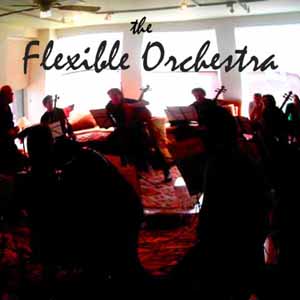
Three years ago, I founded The Flexible Orchestra to explore a different sound concept. Call it dialogue, dialectic, group-and-individual, perspective-added, framing device—these descriptive terms are also the signature of the Western orchestra—in that there is both the massed sound plus the contrasting timbres of other, smaller, differing groupings that can either unite with, or contrast with the massed group. Probably the idea of a massed sound in classical music that is not that of strings came to me subliminally from years of work with gamelan sound. Of course, we already have jazz big bands as well as wind ensembles and symphonic bands. But, similar to the western orchestra, they too are haunted by their own traditions. All were progressive at one time, but now they seem academic and in fact, most of these ensembles are based in educational institutions.

I guess you could say that in one sense, I am “conserving” the orchestra, because the Western orchestra is also an amalgam of the massed sound of multiples, completed, framed, made dimensional by another group of instruments, not necessarily massed. Ironically, I accept the idea that the Flexible Orchestra is a conservative concept; my musical nervous system was surely created and well-oiled in tradition. (My first flexible orchestra was 12 cellos, 3 winds, a discreet, almost traditional orchestra, but the ’06 flexible orchestra has taken the bracing mandate of the non-string massed sound. This year it became 11 trombones, 2 clarinets [all doublings], viola, and percussion.) A gamelan orchestra also combines the non-string massed sound with smaller groupings of a solo string, wind, voice(s), a soloistic instrument like the gender, and of course, drums, which could be called the “conductor,” or at least the time-keeper. In our American gamelan, the drum is not always used, so it becomes one of the “non-massed” sounds in the ensemble, sometimes there, sometimes not.

My vision is that synchronous flexible orchestras could spring up anywhere to co-commission and give composers repeat performances in different places, different communities. Rotating instrumentations would result in fresh ensembles, but they would always have a real orchestral sound. No problems then with the conservative nature of our current unchanging symphony orchestra’s structure and repertoire. As long as there is a counterweight in flexible orchestras!

I hope my work contributes to a renewed orchestra culture right here and now, but I know that one rather small “large” ensemble which can only afford to perform once a year with only two, three, at most four slots for new works cannot do this renewal all alone. Others must help.

A gamelan is an orchestra, so perhaps I’ve been playing in a flexible orchestra for decades. But, finally, with the Flexible Orchestra, I feel like I have found a Western orchestra that is also a gamelan.

***

Excess, Romantic?

Excess, Romantic?  

Charles Rosen recently wrote: “The changes in musical performance registered by Philip were part of a larger movement in all the arts, in paring away the clichés of Romantic excess. Listening to a recording of Sarah Bernhardt intoning Racine makes one laugh today.”*

But excess lives on anyway. Think of the city of Paris’s millennium commission to Glenn Branca piece for 2000 guitars. Well they reneged on the 2000 guitars and Branca got a 100-guitar version done at the WTC in 2001 (pre-9/11). And Robert Wilson’s five hour performances in the 1970’s and Morton Feldman’s six hour String Quartet #2 (maybe it was only five). Excess is not “Romantic” by definition (unless one simply wants to define it that way), it’s style, style, style.  Our contemporary style of excess seems to be to glue people to their seats with no elbow-room or sprawl potential for as many hours as a no-frills transatlantic flight in order to listen to either very few instruments, or many more on stage than is needed to make the requisite sound. Cage, in a friendly manner, called Feldman “an extremist,” rather than a romantic. I’d call all these exhaustion artists the last gasp of the heroic male composer (I’m sure it includes some females). I like some kinds of extremism, that of ideas, that of poetics, that even of personal experimentation with extreme states. But I don’t like the kind that remind me of  Abu Ghraib and Guantanamo.

* “Playing Music: The Lost Freedom,” a review by Charles Rosen in the New York Review of Books (November 3rd, 2005) of Performing Music in the Age of Recording by Robert Philip (Yale University Press)

Conceptual, Verbal, and Graphic Scores

Conceptual, Verbal, and Graphic Scores
by Daniel Goode

A verbal score tells you how to make the music in language, rather than in musical notation. There may be some musical symbols in a verbal score, maybe a graphic, but you are being told how to make the music via language, not musical notes in musical staves to be played by specific musical instruments or voices (though the verbal score also can tell you what instruments should be played). The verbal score is the elephant-in-the-room of the Modernist and Experimental music traditions since it wipes clean the premises of musical notation. Moving from idea (expressed in words and maybe diagrams or sketches) to realization, requires imaginative input from the performers on a level quite different from and more inclusive than what performers do with traditional musical notation. The verbal score can be difficult for a trained musician, and a godsend to a talented, but non-musically-literate performer. A verbal score may ask the performers to do anything, including making up their own sounds, or notes according to the instructions given. Call it the Platonic idea of musical composition because the idea precedes the actual notes, that is, the realization in sound.

Nothing more challenges music Conservatory training and tradition than the verbal score: that you can make music without that musical literacy which the Conservatory is in charge of instilling. The tool of the verbal score does an end-run around that pillar of cultural education, musical notation. It is radical, too, because it steals musical technique away from the medieval power-center of the Conservatory. Yoko Ono may have done the earliest ones in the mid-50s. La Monte Young did a series in 1960 (sometimes these are called conceptual scores, or conceptual music. A full account would include the Fluxus artists such as George Brecht, Bob Watts, Dick Higgins, Philip Corner and others who developed Event Scores influenced by John Cage’s teaching).

The verbal score puts an intelligent agent in charge of finding the right performance for the composerÕs idea, but the performer is also the composerÕs partner, on the same level because s/he is in possession of the concept behind the music, expressed succinctly in words. Yet verbal scores can also be challenging because invariably there are questions about exactly what might be meant by the words, or sentences. And the musicians must be willing to give of themselves, to inhabit the ideas, to do, to compose what is needed to make the ideas into music. A spiritual commitment is required, and the building of a performance community, because there is no such thing as simply playing the score.

Maybe just from this short discussion, the reader can sense what a powerful and flexible tool is the verbal score: first, because it addresses performers in their native language, their first language. And second, because it can say things that notes can’t. In thinking about all this, it suddenly occurred to me to ask what if music notation from its beginnings had taken the form of human language, written and spoken, before it took its familiar form of notes and rests? Wouldn’t the verbal score then be at the center of music culture and music teaching instead of at its periphery? Imagine writers and composers together, teaching the use of language to convey sound, idea, emotion, performance. This is a thought experiment we should all consider making.

Conceptual, graphic, and verbal scores challenge the immovable scholasticism of music theory as it has been taught since Medieval times in music theory courses world-wide, the kind of courses which discourage so many brilliant music students from studying music theoretically. Collections which bring this work to the fore start to redress the imbalance.

Note: this has been adapted from the liner notes to “Philip Corner: Extreme Positions” a 2CD set published by New World Records, 2007.

Authentic Orientalism—Tan Dun

Authentic Orientalism—Tan Dun
by Daniel Goode

March 11th, 2007

I saw Tan Dun’s Metropolitan-commissioned opera, The First Emperor, that is, I saw the film of it at my local movie theater (what a great idea at $15 instead of a $90 Met ticket). It was the most expensive opera ever produced by the Met, and not the prettiest, far from the best, yet amazingly: authentic chinoiserie, because the creator and conductor is a true Chinese emigre composer from Mainland China, a fine musician as we can readily see in the film where he rehearses and conducts and coaxes Chinese rhythmic structure from the Met orchestra (that was my favorite part of the film).

It was as if the composer consulted a textbook on how to make an early 19th century opera, both plot and music (updated with a post-Copland tonal jam). The recipe proceeded: add a thin veneer of borrowed qualities from folk and Peking opera with plenty of generalized, contemporary ethnic sound, pleasant borrowings from Harry Partch, gamelan, flower-pot chimes of ancient China and post Cage-America. Placido Domingo painfully and humanly played the Emperor. It must have been fairly thankless: no wonderful tunes, lots of awkward a-rhythmic declamatory singing, he gets to reign over a lonely, now unified empire (represented by synchronized-swimming-style militaristic chorus); plus no off-spring, a dead son-in-law (protégé from the military killed off somehow). Not a good fate for a great culture, past or future. Elizabeth Futrel (great voice, good actress, matchstick Puccini-type) was the unlucky princess, though cured of leg-paralysis (“you don’t like my legs!”) by—exactly—one illicit love-making scene, she still had to die, and did so, thankfully, off-stage.

It’s just plain unfortunate to say that the music isn’t very good. It doesn’t ever give that special lift and momentum that makes opera work. It’s strangely reminiscent of clunky American opera composers like Robert Ward, not up to Menotti’s craft, lots of spectacle produced by specialist masters such as a Chinese male soprano/dancer who was super charismatic. But these virtues just called attention to the emptiness at the center: A little bit of Puccini-esque pentatonic European harmonizing, the show-off, Carl Orff-like “asian” sounds, some choral glissandos from Buddhists monks—you get the idea. Lots of stuff, not really melding into something satisfying.
And, to further embarrass the most tolerant ethnic sympathizer, a more-than-clunky libretto by the composer and a collaborator with choice lines like: “The dead branches are sprouting,” “dry husks of leaves rattled in my heart,” “You promised to go with me step by step to the summit.”

But maybe I’m just a little sour, because what really annoyed me subliminally throughout was the harsh audio sound, bringing the edginess, not the smoothness of these strong, vibrato-tinged voices to the fore. I had use earplugs some of the time. Movie sound systems are usually cranked up just in general. Here, one really missed the fuller, gentler, acoustic mix of the opera hall. Nobody really sounded good, even in an Italianate, harmonically friendly trio. One melodic tic became less rather than more affecting as it came back often through-out at phrase endings, a fa-mi-do, motive that reminded me constantly of some American theater composer, maybe Leonard Bernstein of Candide. But to start speculating at this level of discontent is madness.

The audience at my local New York theater was quite a bit older than most movie audiences there, sprinkled with true flamboyant artist types greeting and networking. I think these movie broadcasts are a really great innovation for the Met, even with the correctable deficit mentioned. Certainly the low price sweetens the possibility of walking out or taking breaks during slow times. The extensive intermission feature of rehearsal clips and interviews was the best part: lively, musical and all about process and art. If not fulfilled, I didn’t feel cheated. There was a lot to take in, a lot to think about in the three- hour event.

Arranging, a Lost Art

Date: 07 Oct 98 19:15:35 EDT 1998
From: Larry.Polansky@XXXXXXX
Subject: Re: bedhaya
To: dgoode@XXXXXXX

— You wrote:
I am perfectly happy with the title of arranger. It’s the truth! I was just
this morning thinking about how you used MIDI in EK, turning it into a
participatory tool, one step beyond the xerox process, but an important
one.The kind of arranging, transcribing, retooling (with or without computer)
is a lost art in so-called Serious music, used to be quite common, even in
the 19th C. Even Schoenberg did it! I was also thinking of your Skempton
arrangements.

D
— end of quote —
i think of it as composting. speaking of worms… just got back from icmc
(indiana christian music conference!)

we’ll see you in two weeks !!!!! yay!!!!!!!

lp

After Us, No Deluge, But:

After Us, No Deluge, But:

FIRST comes an emotional memorial concert arranged by the loved ones with as many of the performers who know and love the composer’s work as can be found. It’s a smashing success.

SECOND comes the dutifully praiseworthy reviews by all the reviewers who ignored him/her during the lifetime.

THIRD, name-ensembles pick up the more traditionally instrumented and notated works. They obtain the press previews that eluded the composer through most of his/her career.  But reviews, when they come, are already blander cookie-cutter varieties that almost seem narcotized by their own boilerplate.

FOURTH, the composer’s works and press about them fades into the general urban noise of culture.

FIFTH, months later some obscure PhD candidates begin to get curious about his/her works as possible topics for their dissertation. The composer in question becomes the unexploited resource for many would-be academics in music.

SIXTH, all this digging bears fruit in a bevy of college and university festivals which feature the composer’s works and others of younger or older vintages that can logically grouped in with the oeuvre.

SEVENTH, years of this kind of thing continue, but ever more sparsely spaced.

EIGHTH, the composer falls into complete obscurity, much as Hindemith, even Webern are in today.

NINTH, some young composer accidentally stumbles on some scores or recordings of the obscure composer and decides to rip off some salient ideas, in the manner of retro-chic.

TENTH, these ideas get spread around until a genuine retro -period celebration ensues.

ELEVENTH, the elite press, such as it is, reviles the whole movement and snidely criticizes the composers who were the unfortunate subjects of the retro movement.

TWELFTH, outraged descendents of the original composer(s) hit the press and internet with high-level moralistic screeds against the said press and internet perpetrators.

THIRTEENTH. This brouhaha all dies down in a couples weeks, leaving no traces and no follow-ups. Before this happens there is a series of heated back-page exchanges in the successor to the New York Review of Books. Intellectual blood is spilled, but few regular readers of this journal even notice this blip of anger and counter-anger.

FOURTEENTH. Years, decades, even centuries pass, and if culture still exists, no more mention is made of the composer and his/her works.

FIFTEENTH. Suddenly, a very angry artist appears on the scene who wants to castigate the whole culture of high art, and when almost accidentally s/he comes upon the whole history of the composer’s reputation, sees that it is a perfect tool with which to brow-beat the current cultural elite. This artist succeeds single-handedly in causing a broad-based revival of the composer’s work, which lasts and lasts, but finally exhausts itself in a counter-movement which buries even the idea of reviving the past.

SIXTEENTH. By now plagues and global warming have sapped the remaining civilization of any interest in the past except for what guidance previous epochs can give in the struggle for survival, or the techniques needed to escape to other planets.

SEVENTEENTH. Some lonely, disconsolate and depressed individuals seek solace from the disintegrating civilization around them in archives, mementos, and fragments of the music of the composer’s whose works are the subject of this tale. They create a mythology based on these fragments, but sadly, the mythology dies when they do.

EIGHTEENTH. Yet, maybe one, maybe two persons keep mementos of this mythology, so that complete eradication may in fact be avoided as long as human memory continues.

13 Writings About Music 1993-2001

13 Writings About Music 1993-2001

Most writing about music is just chugging along. Why read what is largely boiler-plate, or tunnel-vision reviewing? Or just consciousness raising for the converted? Or just poor writing? Better to put a CD on and listen, or go to the movies.

But I love reading really challenging writings about music: by Cage, by Adorno, by Wagner, by Feldman, by Tom Johnson in the Village Voice, by Alex Ross in the New Yorker, by Schopenhauer, by Debussy, by Dalhaus, by Satie, by Schumann, by Susan McClary, and by whomever has interesting things to say and a compelling manner of saying them. It doesn’t matter to me whether the writing is poetic, journalistic, metaphysical, analytical, satiric, historical, erotic… It follows that I don’t much care if it is found in a review or in an article.

The weakest form of article, one that I regard as essentially a cop-out, is the interview form. It’s dullsville just to plod through the flatness of the form.  Only the very rare interviewee is able to say an interesting thing inside the form. And usually only if allowed to go on and on. Morton Feldman’s 1964 interview with Robert Ashley is so good because it allows an inveterate talker to talk on and on. It gets better with accumulation. Ashley eventually turned the text of the interview, verbatum, into a performance piece (Morton Feldman Says, recently performed by the DownTown Ensemble with Bill Hellermann playing Morton Feldman). Such moments of inspired talking turned into text are probably rare in music. So let’s not make it out as the best way to get inspired music writing.

It’s time to admit something. I like to be inspired, either to think about the music I’ve heard or will hear, or to think about composition and creative issues surrounding it. Perhaps in doing so, the writing calls attention to itself. So much the better, if it calls attention to a thinking mind playing out its ideas. Awful, if either the ideas are dreadful, or the manner of telling is debilitating or worse. Both the fine and the dreadful can be found in a nice little magazine, The Open Space Magazine (published in Redhook, NY and on the web, edited by Benjamin Boretz and Mary Lee Roberts. I am also a contributing editor). It takes time to sort out what’s valuable in a broadminded magazine like Open Space. Especially if one is not a fast reader. Again the CD and movie options beckon.

I don’t believe as René van Peer does that “a review should transcend the personal position of the writer.”  (Musicworks No. 80, page 4). I don’t think it should transcend, but even more, I don’t think it can. A personal position is deeply embedded within any writer/thinker and informs the verbal expression. Even a welter of “mere” opinions may accumulate into a fascinating individual sensibility, or an aesthetic perspective, something that brings the reader some insight even a negative or judgmental insight. These too play a part. Nicholas Slonimsky’s A Lexicon of Musical Invective, is not a trivial book. Jokes about reviewers, parodies of hateful academics, these things can be valuable cultural criticism. I prefer such, certainly, to the feel-good kind of rhetoric found in some nameless journals or little music Blätter. Opinionated prose has a place in music writing. It can also be exhausting. Again let examples be nameless. Even better, supply your own.

I like very much the summing-up last two paragraphs in René van Peer letter quoted from above: Reviews should have a larger aim of relating to issues of concern to the readership of a (any) magazine. Though there is some value in simply having been there, heard that and simply reporting information, isn’t it much better to have this function combined with inspired idea-mongering—I mean points of view and ideas about our current musical, even social or political, concerns? Besides simply reporting is not possible. There is such a thing as simple-minded reporting, but all parts of the writing act conspire to have a point view that filters events experienced.

September, 2001 (Published first in Musicworks, letters)

From a letter to René van Peer, November, 2000 

But about minimalism, you imply differences in saying that Tom [Johnson] was not a minimalist—differences that I don’t think matter to the idea of minimalism. I don’t make a distinction: the fact that certain composers (La Monte Young, or early Glass, early Riley) may have used very few pitches or rhythms and Tom may use more, and also that he uses less obvious forms of repetition, doesn’t make him a non-minimalist in my view. I see the whole spectrum as including repetitive AND algorithmic composition. I think it proceeds from the same source: a rethinking of form (eg. modular forms), a rethinking of counterpoint (phasing, for example, is a canon, but with a difference), harmony (a process, not a set of functional chords), etc. I put myself in this spectrum even if pure rigor was never my aim.

Kyle [Gann] has a medievalist bent: There is an Italian early Renaissance philosopher, can’t get his name back at this moment, to whom Kyle is indebted in some way for his theoretical thinking. Somehow he derives his tuning ideas and other things from this guy. Anyway, his ideas intersect with the ‘systems’ ideas which Tom and others have (David Feldman, a

mathematician-composer), but probably he is more in the direction of Tenney and Larry Polansky, even though these two have been touched by minimalism from time to time. I think Totalism is an un-useful idea,

don’t know what makes something totalistic… But I grudgingly agree that Postminimalism is perhaps a useful descriptive term. Anyway, I can hardly deny its usefulness, since Kyle has officially dubbed me a Postminimalist. OK.

By the way I always HATED the way that Glass and Reich early on denied they were minimalists. Cowards! Western music proceeds dialectically with—isms. Always has, maybe always will, or maybe not! But the denial I thought was a public relations stunt to sugar-coat their musical pills by getting themselves under the radar detector for ‘intellectual music’ which would turn off potential fans and is part of the pop/anti-intellectual tendencies that all American artists have to bow down to, even if they are friendly to pop and other vernaculars while pursuing very different kinds of music.

Well enough cultural criticism for the moment.

It’s good to talk about all this stuff now and then. Thanks!

HARMONY in progress                                         

I can’t believe I’m stuck in a reverie about harmony, chords and progressions. I’ve got a set of chords with three-note clusters on the bottom, various intervals on top. I’ve got another made up of superimposed thirds of various kinds, also a cluster-like sound. I’m separating them into sub-sets, changing ranges of the whole, of the subsets, giving them the Ruggles “test of time” (banging them repeatedly), thinking furiously and getting almost nowhere. Why?

First of all, every arrangement, every connection, every voice-leading is fraught with associations in music from 19th and 20th centuries. These associations bring a penumbra of visceral reaction, a moment of congruence with the “affections” represented in those musics. This yielding to a theory of musical emotion so openly pursued in the 19th Century, and the spillover of that yielding into 20th Century popular music, the opposition to it (while at the same time its use) by many 20th Century “modernists”, the full-scale “retreat” of the neo-romanticists into that vocabulary — all this creates of tangle of contexts which seems to make clear thinking about harmony impossible.

But maybe I’ve got it all wrong. Clear thinking about harmony is really impossible because harmony is this very rich soup of contexts, cultural moments, penetration into the so-called extra-musical. There is no other “uncontaminated” realm.

But if there is, it must belong to John Cage and James Tenney. Tenney’s reflections on Cage and harmony and his own complex multi-dimensional scheme of harmonic space is probably the only theoretical work disassociated from the contextual mess I have painted. Unless, of course, you include the serialist mapping of musical space, where harmony is not considered essentially different from melody because all serial structures and processes apply in a non-differentiated way to both vertical and horizontal textures.

But I do not want to be distracted by either the serial or the Tenney approaches to harmony. I want to immerse myself in the messy phenomenology of chord and progression, because I am intrigued with this messiness and I am composing with this messiness at hand.

What is the moment-to-moment effect, what are the longer-ranged effects, what progressions (in what permutations and ranges) do what musically?

It seems that association, affect, utterance are bound up with each other. A functional bass of dominant to tonic emerges, a “tension/release” progression occurs, a single unresolved suspension, or appoggiatura, or deceptive cadence, or a feeling of suspense from non-resolution throughout a progression. These are unavoidable observations to anyone trained in the sounds of 19th-20th Century harmony. So then the question is, should one try harder to avoid the associations, or should one embrace them and somehow put them to use?

Unclarity, unexpressed motivation pervade the verbal responses of composers. Critics and theoreticians take their cues from this combined inarticulateness and concentrate on style, musical ideology, historical descent of one generation to another. The obvious phenomena and epiphenomena of chords and their progressions are like emperors without clothes: we shall not notice. We listen but we do not observe or are too embarrassed to comment.

One compositional school after another constructs matrices which solve the harmonic problem by papering it over with new paradigms for composition. We have, for example, harmony is nothing but the outgrowth of contrapuntal structures: make your voices according to some principle and that “justifies” the resultant harmony. We have minimalist procedures: take your chordal structures or progressions as givens and subject them to minimalist processes: additive or repetitive, or gradual change, or whatever. The sounds themselves are beyond comment. Serialist theory uses the row and its subsets as the justification for harmony. Only the neo-romanticists and neo-classicists have no theory to account for their chords. Is there less or more than meets the eye in their avoidances? Once pop music is disregarded, jazz seems to be the most unselfconscious in its use of harmony: for jazz, nothing has changed, chords and progressions remain exactly what they always were: the material for “changes” and substitutions, and the fundament for improvised variations. The affect and effect from “the past” is embraced readily and openly with no apology or need to redefine. In fact, the past is the present, as it is with popular songs which use harmony unselfconsciously as if universal and never changing. So harmony continues to be used, the “past” continues in the present, the same intervals, tunings, bass lines, voice leadings, numerals reappear, but all thinking, prescriptive or simply reflective has, it seems, come to a halt.

Which throws it all back on the practitioner of new music. Lost in some never-never land between acoustics and associations, we look for a handle.

Perhaps it would clear the air if we declared that this indefinable soup is the very essence of what makes Euro-American music (“Western music”) what it is. We can’t avoid it and we can’t get outside of it to think about it because it is us.

[to be continued]. First published in News of Music 14, 1994

Harmony—sex

Harmony is like sex. We cannot successfuly analyze it because we are of it. Or is it like the Heisenberg Principle: the closer you get to it, the harder it is to see it. One thing we know about both harmony and sex.  They function. Harmony is functional. It causes smaller and larger climaxes (like orgasms). Sometime it doesn’t work at all, or feels sleazy or cheap. Like bad or non-working sex. All of this is culturally determined. You cannot communicate harmonically or sexually trans-culturally. Or at least it is not easy, takes special attention. The automatic triggering accomplished by the culturally coded rhythmic/melodic context of chord progressions is like the coded sexual signs that trigger an erotic response. If you are not of it, you might miss it. Perhaps harmony is more coded than sexuality, but that’s another discussion.

First published in The Open Space Magazine, issue 1, Spring, 1999.


Harmony Diary: From a letter intended for Kyle Gann, 6/95  

I haven’t tried to analyze the harmony, but two things come to mind:

1) You’re the person to think about the burning issue I’m trying to articulate in this little paper I am enclosing—I’m really curious as to your response.

2) Your harmony seems connected up in some spiritual and technical way to similar uses of poly-modal triadic (especially minor) successions by Vaughn-Williams, and by Roy Harris (I always liked Harris’ version better because it included unexpected 7ths, other dissonances, and sly timbres while Vaughn-W. is just a plain excellent orchestrator, more than interesting harmonist. I put you in the Harris category of interesting). The attraction of harmony is the attraction of “our own culture,” don’t you think?, its depth theme. Then, weirdly, I realize that some of my most passionate harmonic attractions are the way folk music of the Balkans, or of the Andes use the Euro-harmonic vocabulary, but in these truly minimalistic yet powerful teleogical (as in Euro-harmony) ways. Stunning cultural borrowings, more so than any post-post-multi-American experimental composer borrowing from the “East”, let us say. Well, I’m exaggerating, just a little, or going on in a Peter Garland rampage against “Europe”. But no, I don’t really share Peter’s denigration of European music. Just of SOME European music. No names!

Some observations: In Gann’s Sun movement from his astrological studies there’s a very short ritornello-type phrase with a prominent minor-major progression (perhaps some different continuations), but it slots-in the harmonic idea effectively simply through periodic returns—repetition, redundancy. It says: “harmony: listen-up, please.” And it becomes articulate and expressive. More so than if it were a continuous ostinato.

In tying Gann to Harris’ harmonic style, I realize that what I must be focusing on is the underlining of the harmonic strand in such a way as to have it emerge from the texture as a “separate story”—an interesting, beautiful story. Is this the composer’s doing or my own perceptual initiative? Seems that for harmonic progression to be meaningful it must at least be projected (underlined). What else must it have?

What Gann and Harris may not have all of the time is the other necessity for meaningful progression: a sense of progression, rather than mere succession. That is, the routinization of a textures with their distantly-related minor triads simply spinning on as an environment does not of itself make a progression.

Thy Fearful Symmetry   //    Experiences of Symmetry

I recently came across an analysis of symmetry in the music of Morton Feldman. I saw displayed on the page various A’s, B’s , A’s.and X’s in various symmetrical and near-symmetrical patterns. These were to be juxtaposed with the remembered characteristics of certain pieces by Feldman—and this in turn led me to my favorite paradox of musical thinking:

What has the symbol-pattern A-B-A, for example, got to do with my experience of the time slot filled with the thisthatthis musical sequence of moments?

It has something to do with it. The musical sequence shares logical form with ABA. Or, differently, ABA can be used to describe something about that piece of music. But do we experience ABA when we are listening to the piece so analyzed? Perhaps if we are taught to do so. The teacher says: what is the form of this piece. We say: ABA. QED, we experienced ABA. But this simply begs the question of how symmetry is experienced.

Some people (see James Gleick’s Chaos) have lighted on the hypothesis that our sense of beauty comes from our perceptions of environmental patterns with their self-similarities, “crippled” symmetries, disrupted or varied regularities. Considering the appreciation of landscapes across many cultures, landscaping, and landscape painting, it is a seductive hypothesis. Music at the tempo of heartbeat, or in walking rhythms is found in many cultures. But, of course, culture does not always operate in the manner of nature (see Cage’s early writings, and his relation to Buddhism, Zen and other, where he takes it as an imperative that art mimics nature in its “manner of operation”). Still, there are many suggestive relationships between perceptions of natural orders and perceptions of art works.

So, to ask it again: does musical perception resolve into one whole the composed self-similarities a composer makes of, let us say, nested ABA patterns?

The early process oriented minimalists liked patterns uninflected by natural patterns. Tape loop pieces and all loop pieces, in fact, positively declare their “downbeats” to a very sensitive pattern recognition ability of our species. We hear: not-found-in nature. (Let’s exclude the world of motors and mechanized industrial repetitive patterns—they are “manmade” as are tape loop pieces). Loops tell us art or communication grammar is happening. Only when we “cripple” the loops with destabilizing or unpredictable events, do we have the possibility of arguing a family relation between art works and our perceptions of natural patterns.

Impressionism, statistical clouds of Xenakis, environmental New Age recordings of rivers, surf, rain, whatever, these are just a few homages to the varied repetition we seem to see (and hear) in landscapes and soundscapes. Again, can we pass from this to a so-called standard of beauty? Does crippled symmetry become Asymmetry-within-symmetry and vice versa?

I can’t help circling  round and round this issue avoiding the obvious, which is:  Both the crippled symmetry of art and the crippled symmetry of “nature” give pleasure, on a scale from the very slightest to the very greatest. I don’t think that is the end of beauty or of aesthetic pleasures, but it may be just woven in there whether you notice it or not, just staking out a little territory in your psyche. Meanwhile you may be consciously oo-ing and ah-ing over big architectonic constructs describable in music analytical terms only, or the hugely satisfying dramatic structures of late 19th Century symphonic works.  But down there at the unconscious level, that scandalously beautiful double-bass pedal point is just the rough-hewn crippled symmetry of horse-hair bow upon hard gut string. Don’t diminish that perception! You could say that horse-hair/gut perception “softens up” the discerning listener, who can then split their consciousness so that other grand designs are noticed and appreciated.

And what do we think about ABA, again? Now should we try to venture a theory? Well for one thing there is “charge” we feel when it comes time for one of those great recapitulation moments in classical music, pick your favorite—first movement of Mozart’s 40th Symphony, anyone? But that “charge” at the moment the Recapitulation begins is not symmetrical with anything in the Exposition. That was then. This is NOW. So, QED, the symmetry of ABA in music cannot be anything in time-based art like what it is in visual arts. Or am I just being contentious.  The experience of ABA-type symmetry in music has a little to do with the equivalent in visual art. Again because of the basics: same is same, different is different. We parse both the world and art in such basic categories of Same, Similar, and Different, over and over and over again.

ALLEGRO IS IN DISPUTE: CAN ANYONE UNDERSTAND?

Fast music is peculiar, in classical music, in modernist music, in post-modernist music. But not in dance music. Of course, not.  But no, let’s put it differently: Fast music is perfectly understandable in classical music as is tragically slow music. They are both part of the affective inheritance from the Baroque period. Music had specific affects, and in the most simple terms, fast music represented one area of affects and slow another. As the affects disappeared into the modernist period, all medium to slow tempi become just points on a metronomic continuum, not a set of separate things with special characters like tempo di valse, marche funebre, etc. But Fast Music, somehow, resists its disappearance into that characterless but broad continuum of non-fast music

When we say fast or slow we should be clear that we talk of pulsations, event flow, harmonic rhythm (the speed and placement of chord changes). When ever a composer of “contemporary classical” music writes a fast movement or even a fast part of a movement, it almost always has “character” (even if all we can call it is “excitement”), a kind of affect that would lead some Times critic to say things like “a whispy filagree”, “a wild, demonic orgy of pulsations”, “a stark, craggy, elemental show of force”, and on into metaphor-land. Fast music can’t readily be made “abstract” (“absolute”, non-programatic in 19th Century terms) in the way that moderate music and slow music can be.

First published in The Open Space Magazine, issue 1, Spring, 1999.

Class Conflict in Music

What happens when the academic musicologist, turned populist and feminist, attacks the elitist academic serialists (et al) and a representative of the latter who is now a Paul-turned-into-Saul (a non-academic) then defends the academic tradition of music and ridicules the reformed musicologist (above) mercilessly and perhaps properly, yet has nothing more to say in support of the power-mongers of intellectualized music than that it’s a legitimate minority too, worthy of its day in the sun?

No mention in this interchange of the ridicule, of the decades-long, even centuries-long dismissal of vernacular musics as unworthy of culture and education. Those who create the canon and the schooling for the canon, until now, have held this power of ridicule and dismissal. We’re not talking about Schenker and Schoenberg. They weren’t the powers, but they had their views, their insights, their oeuvres belatedly made into the ruling concepts of music.

Cape Breton Fiddling: Introduction

The art of Cape Breton [Nova Scotia] fiddling consists of two things. The first concerns the way a tune is played. The second, perhaps more amazing to me is the art of combining several tunes into one seamless whole.

I became enamored of both aspects of the style in 1972 during  my first visit to the island. But it is about the second aspect that I often obsess, and often try to reproduce when I am playing Cape Breton fiddle music. Let me explain. Because I play the music on clarinet, not violin, I know I cannot produce the exact sound of the fiddler, nor even the exact texture. For instance, I cannot play “double-notes” (double-stops in classical music), and the sound of the fast ornamental grace notes and “cuts” (fast repeated notes which in effect accent—or ornament—a main note) sound differently on clarinet from violin. I’ve found some reasonable substitutions, but the “same sound”—no. Even so, the local players loved to hear me play the tunes on clarinet. I think in their unconscious mind, and for good acoustic reasons, the clarinet sound reminded them of the bagpipe, and in a kind of funny mental cross-cutting, my playing reminds me of a melding of the sound of the bagpipe with the accentual style and drive of the violin playing.

As I understand it, the majority of the traditional tunes played in Cape Breton (and were either brought from Scotland by the immigrants or composed in the new land Nova Scotia) were piping tunes. And piping is still actively practiced in Nova Scotia. Anyway: bagpipe and violin—wind and string equals clarinet.

In repeated visits from 1972 to the present, whenever I learn to play a tune, I work quickly and intuitively to reproduce that part of the sound which is possible on clarinet. And that part is not so much about timbre, but about rhythm, accent, phrasing, and the kind of lilt or lift needed to play the music satisfactorily. Once I have gone as far as I can go with the sound, I concentrate on the “strip” which is what the locals call a medley of tunes made for either dances or for concerts of the same kind of music. Of course, in Cape Breton, a concert usually includes some dancing because individuals will step dance with a fiddler and pianist playing a medley.

I am calling all of this the first of the two aspects of Cape Breton fiddling style. And this is all I will say about it. I want to concentrate on the second aspect: the art of combining several tunes into one “piece” (as we call it back home).

Skepticisms, July’97

Perusing articles in Leonardo Music Journal and Musicworks: Take Truax abstract: “such magnification allows the inner ‘voices’ of such sounds to be explored and their imagery and symbolism to be brought into the compositional process,” LMJ 1992, p.37).  Take the “Skyharp” (sensors map sound and light in an environment, LMJ, 1993). Improvisation and shamanism, Musicworks #66, p.14).

Guiding assumptions: the microscopic is where the essence of our world lies. Or the “giving up” of rational choosing schemes is where knowledge is to be found.

Lethal Aid(e): Text by Connie Samaras, Computer Voice and Music by Daniel Goode, 1993.

—letters and numbers are the embedded commands for the computer voice; respellings also helped the computer to speak better; “embedded” has an unintentional ironic cast during another unpopular war, this one in Iraq.

During the Truman years, a secret government was formed, so that the military, intelligence, and flejling, multi national, corporations, could, creatively, shape, foreign policy without congressional, constraints….. Over the years things pro-gressed nice-lee for the “National Security Council”, but, it, was, with the, election, of, Ronald Reagan, in 1980 that they were able to,   uhcheeve, a massiv, expansion of power……

In testing the limits of this, new, found, freedom, however, they began to fear the risk of public expo-sure.  So, to off set, any public out cry over the discovery of a subterranean, clan dess tine, government operating, outside the, workings, of Congress, they decided to fabricate a boyish heero, embodying the myth of American individualism, to offer the media, should anything go, wrong.  For this assignment, they selected Lewtenant Colonel Oliver North, and, installed him in the basement of the White House.

North, was selected from a group of highly motivayted volunteers by the late director of the CIA, William Casey.  Casey was impressed both by North’s ability to carry out, orders without question, as well as his <<P9 in>>ability to tell right, from wrong.  He also admired North’s creea tivity, which intelligence sighk i etrists, traced back, to the sigh cotic episode, North suffered once he realized, the V et nam War, was truly, over.  This, the CIA felt, could be, a plus,  since North’s assignment was to impliment, what they considered, imaginative, unconstitutional, acts, like, invading Grenayda, and allowing no, press, coverage;  mining the waters of Nikkawrawgua;  stepping, up, a rain of, tehrr rer, and mass murder in El Salv a door;  bohming, Libbia;  financing a group of mercenaries, in Central America, by selling arms to Iran.

Beecause, North was hired to play a po ten chul, scape, goate, Casey wanted, <<P8 equilly>>, creative people, available, to work on, North’s, trial, image, should charges, be pressed.  En<<P9 curraged>> by colleagues who had begun collecting, art, with new, found, wealth, from upscale trafficking in druggs, Casey expanded the, arte, department, at the CIA and instructed them, to assume, a more, avant-garde approach, in their media constructions.

As it turned out, North did go to trial and the people in this division got to try out many of the ideas they had worked so hard on.  For example, they had drugs administered to North to make his voice crack so that he would appear sin ceere and boyish, every time he opened his mouth.  They hired a former model for his secretary knowing that the two would be ro manticly linked,  making people feel, less, resentful that the heerings were displaycing, daytime soap operus.  They designed one of North’s medals so it would look like a happy face when pho toe graphed by, video camerus.  A, TV, movie was scripted of his life and times.  The Quaker, Oat, box, lo go, was, digitally, altered to resemble Jehrry Falwell, thus preparing Americans for the preacher’s campaigns to raise money for “,paytriut, Oliver North’s Deaf ense, Fund”.  But the most siphisticated concept they developed took into account the spectator’s actual, physical, environment during the media, <<P9 event>>.

Having access to both Nassa’s, and the EPA,  pro jections of the Greenhouse Effect, they decided that the siveere climatic changes in store, would provide, the perfect, interactive, settings to induce, mass delerium, through real time, television.  Thus, North’s appearance at the 1987, Ir ran/Contra heerings was,, deelayed by his council, to coincide both, with the fourth of Ju lie ,,, and with one of the worst heat waves, in recorded history.

Next,  knowing that July 4th 1988 would again bring both record high temperatures, and also one of the worst drouts since the, 1930’s,, <<P8 and>> because they had been, instructed, to a sist, ex-CIA director George Bush’s presidential campaign, they decided to blow up, an Ir ranian, jet, airliner, on the third of July, so that it would dominayte the news, coverage the next day.  Not only was this event staged to, dis so siayte, Bush, from North, and the Ir ran, contra scandal, it was also thought that the heat-crazed, public would enjoy the pictures of the explosion once fire works had been <<P7 pro hibited>>, in most parts of the country because of the drout…

Finally, when it was clear that North would be convicted, they had his sentencing delayed to January, 1989, because it was pro jected that the country would experience a, four, week, thawh.  at the beginning of that year.  Since the fawlse sense of spring would uplift everyone’s, spirits, it was hoped that this would make for a more fayvrable reception of the, ri<<P9 di>>culusly, light sentence North was, slotted, to rece<<P8 eve>>.  200 hours of community service, enlisting North as a “soldjer in the war against drugs”.  This sentence, also designed by the art, division, of the  CIA,  was not considered an ending to the North episode, but rather the beginning of a new project for the upcoming deck aide.

Because of pro jected changes in the Soviet Union and Eastern Europe, it would no longer be, va ya bul, to package, agendus, for social control, under the simple banner of, “fighting the cancer of communism”.  Instead, new guises, had to be devised,  the first of which was Bush’s pledge to.  “<<TV9P6 battle, this, plague, of drugs, upon, <<P3 our, <<P7 lande>>.

SECRET CAMERAS—IN NEW YORK CITY

You are peeing against a wall because there are no public facilities for blocks.

In a park, you are hidden from passersby, yet fully clothed and furtively masturbating in the front of a secret camera.

Two people are passionately kissing—is one harassing?

Two people who could never marry are passionately kissing.  They are the same sex——in a public library. A camera catches them.

Once cameras have reached a critical mass, they create “a total institution” (Erving Goffman).

Or as [former] Mayor Giuliani put it: “You don’t have an expectation of privacy in public space.”  So don’t pick your nose.

First published in The Open Space Magazine, issue 1, Spring, 1999.

From a letter to Ben Boretz, February 9th, 1999.

…I’m stimulated. The words Situationism and Improvisation, the Disembodied voice are bouncing between my earlobes, making a deafening racket. I’m now going to go off half-cocked with ideas for the near future:

I want to actually talk to mainstream culture-makers. Actually I want to assassinate them. To do that we must put acid on their neural synapses.

Let’s see. Radio has been betrayed. We wuz robbed. The most enlivening, immediate medium for musician-thinkers and musician-doers is radio. Forget the internet, it’ll be problematic for too long a time. The obvious access and portability of radio that needs nothing but an on/off switch and a tuning dial (alright! a gain dial and an equalizer as well) argues that it is the most: democratic/powerful/potentially radical/cheapest/free-est from the necessary intercession of the priest-technician who ministers to the fallen and crashed computer—this amazing thing has been closed down, gagged, neutered, imprisoned, commercially exploited as both commercial and “Public Radio.”

Well, examples to follow. But when you said on the phone we needed a magazine to talk to each other, I thought it over, and I find I am too angry at the culture to leave it at that. I want us to have a razor sharp analytical voice that provokes the culture makers directly to respond to us. We should not let them off the hook. They claim to speak our language (radio, TV, media people), so let’s not be crank-letter writers any more (here I am swearing off an abominable habit that simply has put a lot of my energy directly into the Round File), just complaining one at a time so we can be dismissed one at a time.  I want an association of pragmatic thinkers who will take on these targets mercilessly.

Here’s one little koan from “public radio.” A very hip, varied radio program called “Afro-Pop World” used to be broadcast on WNYC-FM (our “public radio” which Giuliani just off-loaded to corporate and foundation funders). When the station went “independent” (that means that marketing replaced programming, to suit those very corporate and foundation funders), “Afro-Pop World” was switched to the AM branch of WNYC. Though at a handicapped hour of midnight on Saturday night, that’s not the koan I’m after. Rather it is: Why AM, rather than FM? Answer: FM is better quality sound, so it is for better quality music. Folk music, ethnic music, pop music, African music is not serious music. Now this is what the elites of Columbia and Princeton music departments used to say out loud for decades and decades. But here is an act by the so-called makers of the public, non-elitist culture that deconstructs into exactly the same statement.

After our victory over public radio, we should work on the creation of physical spaces for our thoughts (that includes music, of course). We can use the internet, but we should use it to valorize the physical meeting ritual. Every time I see people lining up for a live event (usually young club-goers in Manhattan) it is brought home to me that the meeting place is still the locus mysticus. People want to rub up against each other in every sense of the word. The internet will never replace that. Tell a friend that something “really happened” at such and such a place and time, and that you were there to experience it; relate it, and you will make your friend jealous for not having been there.

Well, now that we’ve taken back public radio, and we’ve re-valorized the ancient idea of the face-to-face meeting place, nothing will be denied us. What next?

Let us reform the movie sound-track. Film (and video) is the lingua franca of the 20th and 21st century. So, what the hell is going on in those “treatments”, those pre-sold sound tracks, those enervating under-scorings, those bloated pig-bellied blockbuster sound tracks?

We should take on the poor (but getting richer) deracinated composers who make them, and their sound editors, engineers, and all their bosses. Our leaflets should pour down on their heads. We can embarrass them, and once exposure comes, well, some will at least be politicized, even if they can’t change their producers’, directors’ minds.

Finally we have to take on education. A young musician told me that when he asked his music professor at a large Texas university what was a gamelan, he got, the response: Debussy was influenced by the gamelan. When he persisted with his question what is gamelan music, the teacher, after a week, came back with a one-sentence definition from a dictionary.

But education will just be putty in our hands after all of our above accomplishments. After all, we spent our lives in education. We know how to handle “Them.”  And we will! We’ve got the contacts!

All the best! Daniel