(2009 by Carl Fischer in Frog Peak Newsletter #17).
It’s always good news when the craft and art of orchestration is brought up-to-date by a significant composer-practitioner. If you think about it, what an orchestration book is—is a labor of love for a composer, who might better spend the time actually composing and orchestrating. Such texts have been, traditionally, odd combinations of lists of important trivia (like the ranges of instruments) and real hard-earned practical experience in the use of these instruments, sometimes with innovative ideas from the composer’s own compositions (viz. Berlioz). Brant’s handbook, begun when he was a teenager in 1932, is an outlier in some ways. It doesn’t do either the basic manual task, or a grand synoptic view of contemporary orchestration. It is an unusual book. There is nothing quite like it.
You can count on three fingers such recent examples of composer-written orchestration books. Walter Piston’s useful, compact Orchestration (1955 by W. W. Norton and Company), Larry Polansky’s New Instrumentation and Orchestration: An Outline for Study (1986 by Frog Peak Music). This one is a course outline with all the important categories, but not the examples or commentary. And now Henry Brant’s “handbook.” One might use a fourth finger for books—neither manual nor guide—like composer Robert Erickson’s 1975 Sound Structure in Music, an important analytic study of timbre and texture in contemporary music. Other specialized books for jazz or avant-garde and experimental music are not by important composers, though some are certainly useful guides for students.
The hard demographic truth is that few young (or even any) composers unless in a privileged conservatory setting, are going to have the full palette with which Brant quantizes his results. For example Brant often lists: 18 violins, 2 bass clarinets, contrabass clarinet, and so on. Where will you find these outside of a well-stocked conservatory, or in a movie city with movie budgets to hire any number and types of instrumentalists?
So trying and testing Brant’s examples is going to be out for most of us. We’ll have to trust Brant until and unless our own use of his precepts fails in some way. Particularly in the “American system,” it can be hard to test orchestration ideas because there is limited access to expensive instruments. With aggressiveness, a young student composer in a conservatory might have the moxie to bring together these instrumentalists, cajole, or otherwise lean on enough levers of instrumental power to try out Brant’s extravagant combos—or even invent his or her own. But most students will not be able to do this.
By definition, orchestration books are “how-to” manuals, practical and not theoretical guides. This is hugely true of Brant’s handbook. In his manual, published posthumously in 2009 a year after he died at 95, he makes absolutely no mention of the significant 20th Century advances in acoustics (like formants), or psychoacoustics (like auditory streaming). He doesn’t analyze the noise-to-pitch continuum, nor even, perhaps most significantly, give us any inkling of his vast knowledge about spatial separation of instruments and instrumental groupings, and how this would affect orchestration. That he omits any mention of his self-proclaimed life work, spatial music, seems strange at first. But read on! There is, I believe, an explanation.
But (a big but!) this doesn’t make Brant’s handbook any less important. It is vastly so! My message is this: whatever I say as critique of his handbook, you still must read it if you use orchestral instruments in your music.
Let’s take two case studies from Brant’s handbook:
CASE STUDY # 1: THE UNISON
Composers, arrangers, and transcribers create unisons among instruments as routinely as Moliere’s character speaks prose and is amazed when told that he has always done so. Brant would have us be a little more amazed and reflective when we assign the same note or line to two or more instruments. Normally it’s crude practicality that governs the choice of unison: we have just these instruments available when we either need or think we need a unison sound. Sometimes it’s as simple as: let’s give a player something to do for a while. The only question we need ask ourselves in this instance is can they do it. If we’ve thought about unisons theoretically at all, it might be with these things in mind:
—The Balinese practice of tuning pairs of instruments just off the unison, which gives that famously brilliant shimmer to Balinese gamelan music.
—The not-quite unison texture called heterophony found in religious chanting and much experimental music. In the former it is pitch and rhythmic discrepancies of “untrained” voices on the same melodic line—which we usually find beautiful and moving for complex reasons, musical and cultural.
—The fascinating psycho-acoustical study that found the “just noticeable difference” in frequency which can turn a perceived unison of two tones into the experience of two separate tones.
Enter Henry Brant with Chapter 9: Unisons. Actually let’s briefly step back to another account of unison texture, that by Walter Piston in his 1955 orchestration text. He gives wonderfully subtle analyses of D’Indy, Beethoven (his 9th), Stravinsky (Symphony in Three Movements), and Debussy examples. But Brant at the head of his chapter, using his own created examples (as are all of his examples) immediately puts us off balance by exemplifying the misuse of “accidental” unisons; then he proceeds to “passing unisons” and their cost to “harmonic balance.” The whole discussion is on a level of acoustic detail that must be unique in the published literature. One of his distinctions is between the “expressive unison” with hybrid tone-quality, and the “functional unison” with “nondescript character…well-blended…” Altogether he has six categories—of great interest and observational clarity. Chapter 10 continues the discussion logically with “octaves and double octaves.”
But unison pedagogy keeps cropping up in other chapters as well:
—“Three-way Unisons: Definite Pitched Percussion and Piano” (p. 156) in Chapter 33, Piano as an Orchestra Instrument. This whole chapter is an important contribution in looking at our familiar piano in an analytic way as just another member of the orchestra. Take the middle range of the piano—the range of the solo and jazz repertoires. This is the least valuable for the orchestral piano; the outer ranges (low and high) are most valuable, says Brant. This could be a modernist tick of his, but probably is statistically true, since piano in the orchestra is a modernist addition.
—Harp and harpsichord unisons (p.165) in Chapter 34: Pizzicato Timbres. Brant is persuasive in treating all pizzicato instruments as the useful category, bypassing the usual division into different “families” of strings and of keyboards.
—“A Single-Line Melody Played by One or More Unison Sections” (p.196) warns that full string sections tend to cancel out the nuances possible to solo string performers—a really good lesson for many of us composers who want whole string sections to “fiddle” as would a solo folk fiddler.
—Unison strings (p.213). This long, 26-page Chapter 38 is devoted to Bowed Strings. It is the counter-part to the pizzicato chapter. At the end he gives a formula for the best unison groupings for delineating “outer parts.” He also claims that unisons of muted and unmuted strings are “non-mixing and of poor resonance.” I’m not sure I would accept such a generalization, though I don’t discount it either. Since strings are the core of the modern symphony orchestra, his account repays close attention. It contains, for example a discussion of “fullness and thickness.”
This “thickness” (which also means harmonic thickness or density) is a characteristic of most of the examples composed by Brant for this book. It could be said that this is a stylistic property of his music in general. To coin a word: his “choralizing” textures are something you can notice throughout his oeuvre. The advantages of composing your own musical examples in a book of this kind are obvious: first it saves time scouring the literature for exactly the right orchestral moments to use from thousands of compositions of many eras. Second, the examples can be tailored exactly to the point at hand, without extraneous distracting musical contents. On the other hand, examples sought out in great music impress the point more forcibly because their whole message is served by inspired orchestration. But Brant’s composed examples are not routine either. By about a third of the way through the book, one notices they are becoming ever more detailed, longer, complex and rich in sonic qualities. It wouldn’t be wrong to actually play many of them as short compositions on a concert program. He almost encourages this in his important Foreword—which has his many disclaimers of what the book doesn’t do—when he says: “Examples of three bars or more are regarded as expressive [compared with shorter ones he calls functional], indicating one or more complete musical statements.”
Bowed Strings (chapter 38) gives us a chart (p.190) of how different sized string sections should ideally apportion the number of instruments among the five sub-sections: violins through contrabasses. He says that centuries of experimentation have standardized these proportions so that progressively fewer low instruments are needed: because “longer vibrations” (he must mean wavelengths) of the lower pitched strings “need fewer players for the sound to carry adequately.”
Unison mixing of strings and winds (p.222): “To produce an ‘enriched’ string timbre, the wind component should seem to ‘disappear’ in the total amalgam.” This is done my marking the winds at a lower dynamic than the strings. And by omitting wind vibratos. The issue of independent dynamic markings for different sections of an ensemble moving together in time is fraught. Some would argue that the conductor should make micro adjustments to the dynamics in the context of performance. Brant and many other modernist and even late Romantic composers choose for very knowledgeable reasons to do this kind of micro-marking themselves.
There are probably many more references to “unisons,” (see Appendix 4: Expanded Unisons) throughout the text, as well as musical examples using unisons. This is not an easy book to use. There is no index to look up “unisons.” We should all write the publisher, www.carlfischer.com, to ask for a new edition with an index—and be sure to add, when you write, that the musical examples should also be indexed throughout the book wherever they show the important concepts (like unisons) at work.
CASE STUDY # 2: “GROUPS OF CLOSELY RELATED INSTRUMENTAL TIMBRES.”
Perhaps Brant’s boldest idea, one most dismissive of convention, is this disassembling of the traditional categories of “instrumental families:” woodwinds, strings, brasses, percussion, and their recombining in new categories. Here is his text on wind instruments, verbatim:
Wind Timbre 1: flute family, clarinet family, bassoon (top octave only), strings (in harmonics only), horn (restricted range, fiber mute only), pipe organ (flute stops only)
Wind Timbre 2: muted trumpet and trombone, horn (hand-stopped or metal mute), all double reeds, clarinet family (bottom fifth only), pipe organ (reed stops only), accordion
Wind Timbre 3: open horn, trumpet and trombone “open in hat” or equivalent, muted tuba (all in restricted ranges), all saxophones (top two octaves only)
Wind Timbre 4: open trumpet, flugelhorn, trombone, tuba (full range), horn (full high range), all saxophones (full range)
In an important addendum to this list (p.54), he gives his idea of what the model or prototype instrument is for each of these four groups, respectively: flute, oboe, horn, trumpet, the latter two without mutes.
As you can see, he mixes up traditional families, even including strings in Timbre 1. His justification for doing so is repeatedly shown in examples. A lot of the reasoning has to do with what I might call “thick” and “thin” tone qualities. And also, complexly, with overtone structure, but he never explains anything acoustically, so this has to be our own analysis. Another favorite word of his for certain textures is “nasality.” In the body of the text he does exquisitely detailed annotations for these textures which account for the different strengths and loudnesses of the instruments in their various registers. We can see even in the outline above that he uses mutes (e.g. “fiber mutes”) as a tool to match brasses in their groupings with other instruments.
This classification of wind timbres is ear opening if you can imagine them. And counter-intuitive simply in the idea of breaking down hard walls among the traditional “families.” You may want to resist, as I did at first, because of his orchestral abstractionism: for example, he combines string harmonics with muted horn (Wind Timbre 1). I wanted to rebel because of the concrete gesture needed to play these sounds puts them in different worlds. Perhaps Brant, as a world-class orchestrator who made recorded sound tracks for films, thinks only of the sound coming at a distance to the listener: a massed, blended sound from within the orchestra coming through large theater speakers. I, on the other hand, picture his combos as if I were sitting listening to a live ensemble.
Another reservation to Brant’s re-configurations occurred to me when thinking about an audience’s experience of a large orchestra. Imagine, for example that you are listening to a beautiful chord played by members of Brant’s Wind Group 1, say a flute, a harmonic on violin(s), pipe organ, and muted horn. What do you think the effect will be on blending when these instruments are modulated by the large physical spaces separating them? I think it will greatly affect the blend, unless you are listening on the radio, or are very far back and high up in the concert hall. Now hold that thought, because I want to remind you that earlier I noted, incredulously, that this composer of “spatial music” has absolutely no place in his handbook for physical separation in any of his conceptual mappings, categories, and musical examples. The reason, already hinted at above, is that Brant, the expert Hollywood orchestrator, assumed the studio-produced result that blends and mixes down recorded instruments into a film’s sound track.
In a live concert hall rendition, the listener will experience my imaginary Wind Group 1 (above) as a kind of spatial dissonance. Something like “sonic athleticism”—each sound reaching across space to its brother and sister sounds, or perhaps in another image: the cantilevering of a sound bridge between and among the various sound sources. This is indeed a stimulating pleasure of large orchestra music from Berlioz, through Mahler, and continues in our own new music styles of early Modernism to the present. But ironically, it is not a part of spatial-composer Brant’s way of treating orchestration. I think it’s a deficit in his whole project. In reality, music is spatial or on a spatial continuum. Timbral combinations are always “modulated” by physical placements in space and architecture, and then heard in relation to the listener’s place in the hall.
NOTES AND REFLECTIONS
What follows is a collection of comments on specific points about, and examples from the Brant text, with a few of my general reflections which the book stimulated.
The long (54 page) section titled “General Premises” is a must to understanding the handbook. For example, Chapter 3, Harmonic Balance begins:
“Much of the discussion in this book concerns procedures for obtaining balanced harmonic textures.”
Each “chord” must sound as “one unit,” and no notes “protrude, disappear, or seem foreign…” Though I’ve noted Brant’s “choralizing” tendencies which this premise readily lends itself to, he does have some really interesting short chapters which do not relate to “balanced harmonic textures.” Just a few of them are:
Vibrato (Chapter 14)
The Termination of Long Notes (15)
Joints and Separations (16)
Extreme Registers (17)
The Piano as a Pitch Guide in Preparing Musical Materials for Orchestration (44): “The piano cannot, however, be expected to provide an accurate forecast of the impression of vertical pitch relationships…if the texture is intentionally heterogeneous…”
Equivalents of the Piano’s Damper Pedal (20)
Percussion Timbres (25): His primary categories pre-empt the usual first division of percussion into definite pitched and indefinite (or unpitched) instruments. His two types are:
- Instruments producing staccato attacks only.
- Instruments that have a quickly decaying “carry-over” to the initial attack.
Yet his percussion examples often use vibraphone which with its damper and motor are just about fully sustaining instruments.
The Roll (30): He warns that all definite-pitched percussion instruments “gain in distinctness at low dynamic levels” when rolled. Soft-headed mallets increase the clarity. He takes up rolls of 2, 3, and 4 pitches.
Nineteenth and Twentieth Century Tendencies in Orchestration (Appendix 3).
I don’t think Brant thought or cared for a moment about who would use this book. It is impersonally addressed. This makes for a big disconnect with the younger generations of musicians and composers who easily use in combination: live and electronic sounds and timbres, sampled sounds, notation systems like Finale and Sibelius which come with their own library of orchestral (sampled) sounds, computer produced sound. He’s off the hook at least in the sense that his Foreword has this disclaimer: he can make “no assurance” that these kinds of sounds will “produce the same or equivalent results” as the combinations of acoustic instruments he writes about. Again, I must note the class issue here. Young, unconnected composers will not necessarily have access to the high-end, expert players of acoustic instruments. So of course, these young or unconnected musicians will find substitutes in the form of samples, synthesizers, processers, computers, recording and playback devices.
Harmonic Imbalance: Though he wants to discourage this state (at least when the orchestrator wants balance), one of his key examples is interesting and tempting to use. He has (p.9) four flutes marked forte on their low C and three trumpets with the same marking playing the G, C, E above (p.9). He says the flute “will scarcely be audible.” But interestingly the low C will be reinforced by the difference tone, C, produced by the G-C-E, an octave below the flute C. Sure softer, but what an effect! I want to hear it.
A composer friend once commented that one of my ensemble pieces (Tunnel-Funnel) was “about orchestration.” But everything is about orchestration. Some of the most exciting moments in both 19th and 20th Century scores are “awkward” or off-kilter balances that just happen to work. Look at Stravinsky, Varese, Janacek, Mahler. Of course there are also plenty of examples of Brant’s “choralizing” textures, too. Folk bands may have “unresonant” combos that simply force the issue of blending through expressive playing, or an intimate understanding of the idiom. For example the Cape Breton fiddling accompanied by guitar was originally used if no piano was available, but became an acceptable sound in its own right.
Brant addresses the problem of balancing a progression where chords vary in number of tones (p.32) by asking the orchestrator to get at least an approximate equality of players on each tone of the chord, resulting in harmonic balance, but varied “thickness.” He doesn’t mention that this could produce a kind of “tone color” melody of thickness or thinness, related to Schoenberg’s tone color melody, famously found in his Five Pieces for Orchestra, Op.16.
Homogeneity is a constant concern of his. He says (p.59) that it is decreased by putting dissimilar timbres adjacent to each other in harmonic textures. It is also disturbed in Wind Group 3 (see above) by vibrato (p.78), though he also admits that vibrato adds “resonance and expressiveness” as it does to a string quartet.
Some of his examples are just eccentric and fascinating, so, for example he’s pointing out a horn on F above middle C, at a piano dynamic will be soft and “thick” while the piccolo three octaves above on D, at a forte dynamic will be loud and “thin” (p.10). Are we taking such things in, dear composer-orchestrators?
Juxtaposition of different timbre groups (p.11), he considers better than “enclosure” or “interlocking” because there are fewer “intervals of contact” [between notes of different Timbre Groups].
In horizontal (contrapuntal) writing (p.12), he recommends that each strand keep its respective timbre even if it causes interlocking or enclosure. This seems to preclude pointillist orchestrators like Webern, or even Mahler. So, a conservative moment in Brant. Like Max Reger was among the 19th Century innovators.
Dissonance. That’s the title of Chapter 7 (p.13), another first for Brant, in that he treats it at all. He tells us, for example, that to emphasize the dissonant intervals, keep them within the same timbre group—a forward-looking moment to open up dissonance to the same status as consonance in the project of orchestration.
Composition finally, definitively merges with orchestration (p.17) when he shows how to impart “rhythmic motion to static harmony,” and how to “produce contrapuntal motion upon tones of static harmony.” This last example has an elaborate chart where lines are divvied up using groups of flutes, clarinets, and violins.
He shows how to add octaves-pairs in a contrasting timbre (p.23), which allows the higher of the pair to be played at a lower dynamic level. This is subtle and canny knowledge.
A triadic assumption (p.24) leads him to say that widely spaced groupings should be unified vertically (harmonically) by using the same timbre. Knowing his assumption allows us to disagree with this as a hard and fast rule.
Uniformity in Articulation is a short, pungent chapter (13), which has an ingenious solution to a problem you never knew you had. Where there are common tones in the same voice in succession, and you want to keep uniform articulation among the voices: instead of creating long notes or tied notes, exchange parts so each voice always has a new attack (p.34).
Chapter 17, Extreme Registers, points out that auditory perceptions in these registers becomes more difficult at fortissimo dynamics, but is very good at lower levels (p.42).
“Accordion in Wind-Group 2 Textures” (p.75-76): A detailed section on accordion may also be a first for orchestration books. He shows, for example, which accordion stops intensify the effects of the other winds by putting octave duplications outside their ranges.
“Non-Harmony” (p.135) raises the seldom-discussed fact of the non-blending of dissimilar attack transients in different kinds of indefinite-pitch percussion instruments like: snare drum, maraca, ratchet, tambourine, castanets, wood block. Simply coordinating attacks among instruments that produce tones in different ways is difficult. But his point is that even with a simultaneous attack, a blend will not occur. Once more we see his value of homogeneity put above its opposite. For some composers the non-blending might be quite acceptable, even desirable.
I would generalize the point to say that in any vertical (harmonic) array of instruments, blending is decreased by dissimilar attacks. Sometimes when I’m sitting in a concert hall, a harmonic progression familiar to my mind seems very strange when passed through the actual instruments. A really interesting study of blending, homogeneity, separateness could be to look at say, Mozart, Mahler, and Messiaen textures in actual performances in their acoustic spaces. What is the intention and what is the effect?
This important book, exhausting and also exhaustive in some ways while inadequate theoretically in others, ends with his “Epilog [sic]… To those everywhere who originate sonorous combinations rewarding to the nervous system and describe them accurately, I wish every success. —Henry Brant, Santa Barbara, California, 2007”
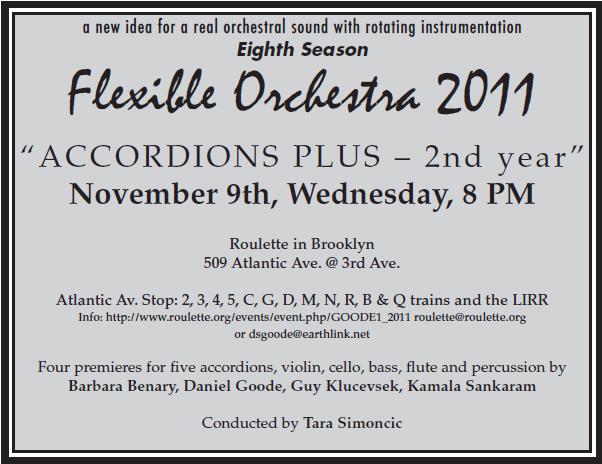
 Daniel Goode, composer-clarinetist, is founder of the Flexible Orchestra – a new concept in orchestral sound, co-director of the DownTown Ensemble, member of Gamelan Son Lion. On November 9th, Goode brings his Flexible Orchestra to Roulette.


 Daniel Goode